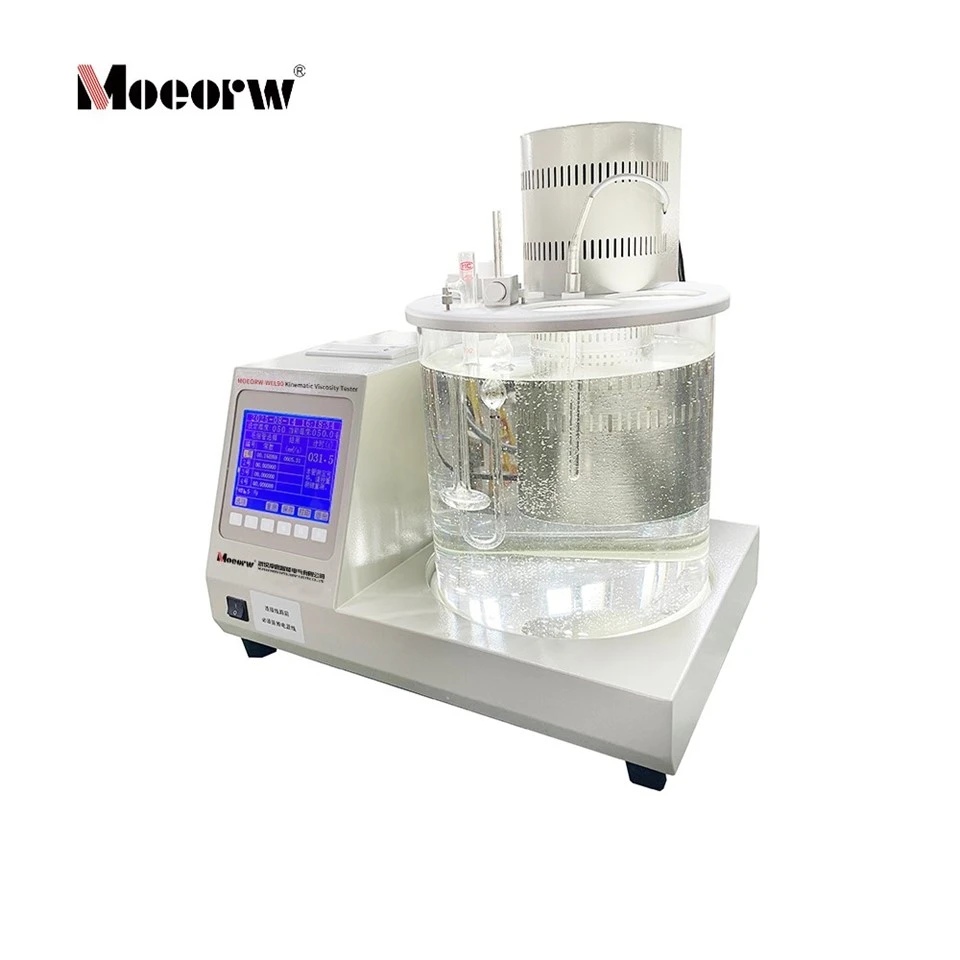
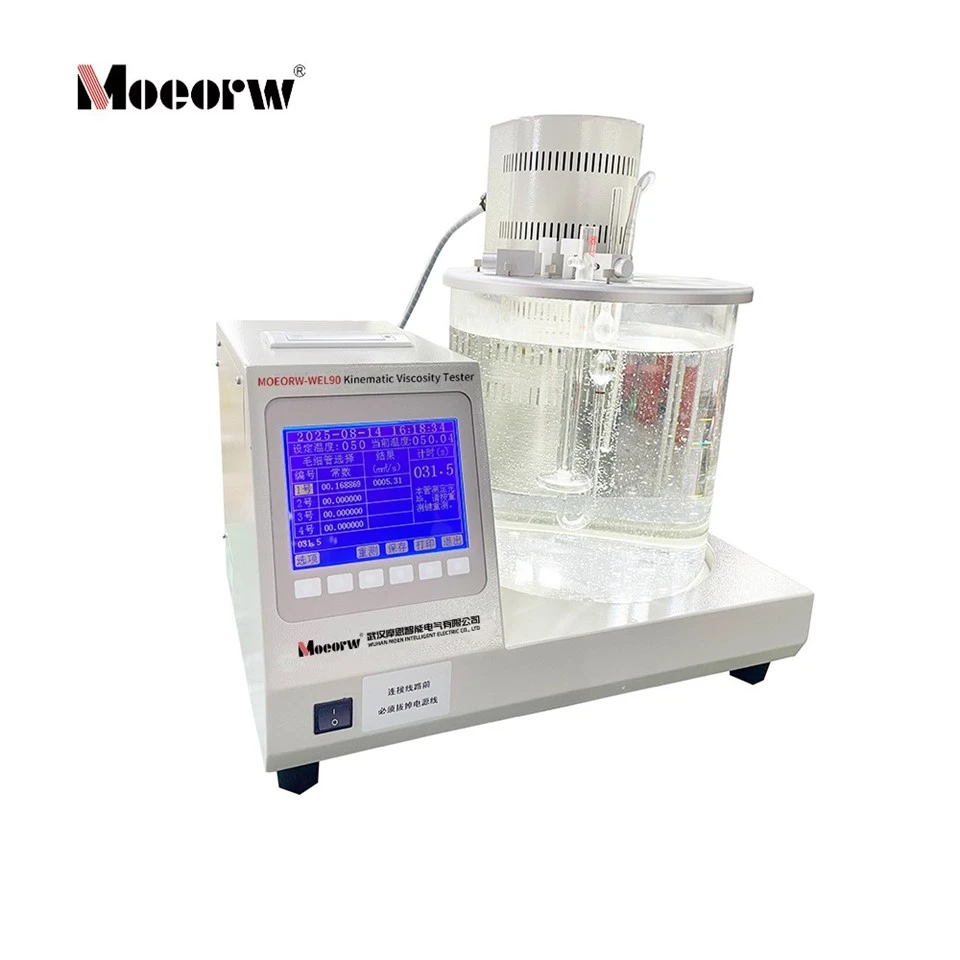
Product Overview
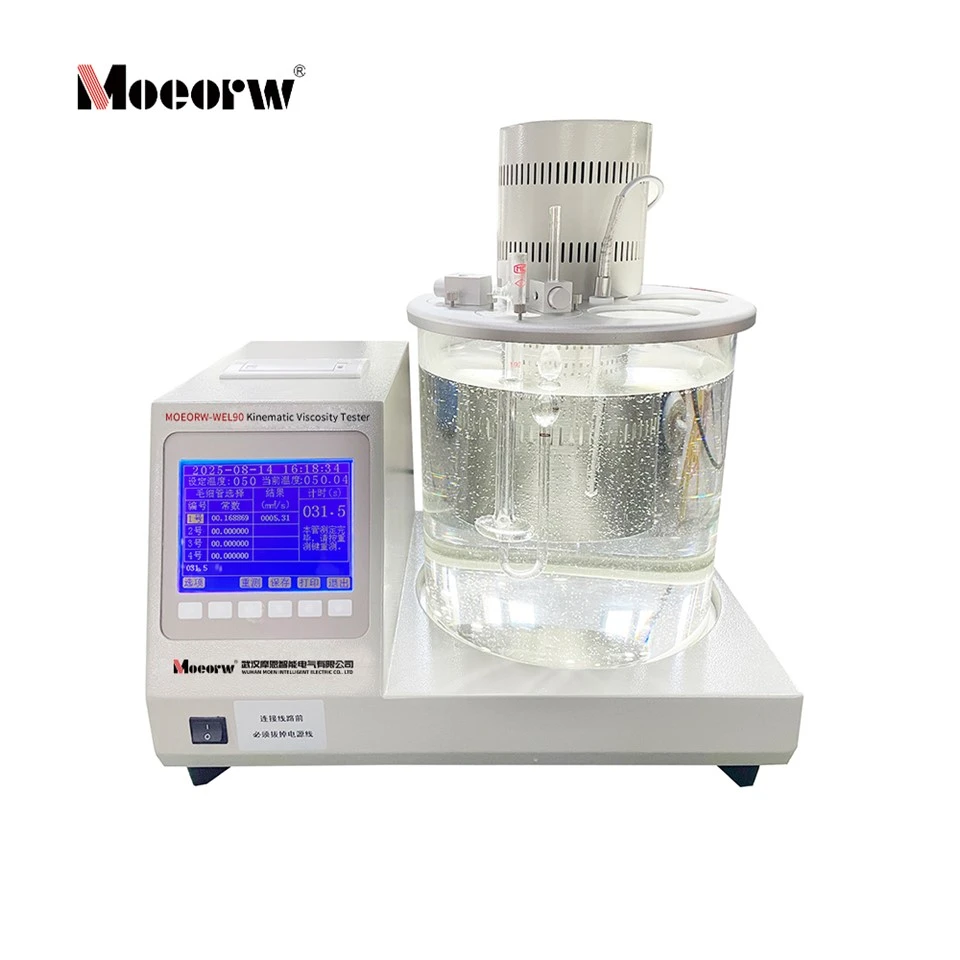
The MOEORW-WEL90 kinematic viscometer is a dedicated testing instrument developed in compliance with national standard GB265-88 for Petroleum Products – Determination of Kinematic Viscosity. It is designed to measure kinematic viscosity of Newtonian liquid petroleum products.
Working Principle
Under a constant preset temperature, a fixed volume of sample liquid flows through a calibrated glass capillary viscometer driven by gravity. The product of capillary constant and sample flow duration equals the kinematic viscosity of the sample at the test temperature. Dynamic viscosity can be calculated by multiplying the measured kinematic viscosity with sample density at the identical temperature.
The unit of kinematic viscosity is m²/s, with mm²/s adopted for routine industrial testing.
Technical Specifications
|
Item |
Parameter |
|
Temperature Control Range |
Ambient ~ 150°C, full-range adjustable |
|
Bath Hole Quantity |
4 holes |
|
Temperature Control Accuracy |
≤ ±0.05°C |
|
Input Power Supply |
AC 220V±10V, 50Hz |
|
Heating Power |
1000 W |
|
Mixing Motor Speed |
0–4000 r/min |
|
Ambient Operating Temperature |
0°C ~ 40°C |
|
Relative Humidity Requirement |
< 80% |
|
Maximum Test Record Storage |
255 groups |
|
Adjustable Test Cycles |
1–6 cycles (4 cycles as standard per GB requirement) |
|
Fine Temperature Adjustment Range |
-3.0°C ~ +3.0°C |
Core Functions & Characteristics
1.Hardware & Structural Design Compact small-volume constant temperature bath with built-in lighting for clear sample observation; LCD Chinese character display with physical white key panel for intuitive operation. All set parameters are automatically stored via onboard memory after one-time configuration.
2.Temperature Control System High-performance microprocessor equipped with digital PID temperature regulation module, delivering wide adjustable temperature range and high constant-temperature precision to stabilize test environment.
3.Data & Timing Module Built-in non-power-off calendar clock to display real-time time after startup; automatic timing of sample flow duration, automatic elimination of outlier data and kinematic viscosity calculation after completing preset test cycles.
4.Data Storage & Output Support storage of up to 255 groups of test records for later review; integrated high-speed thermal micro-printer supporting real-time printing and offline printing of historical records. Optional network communication module for remote control and centralized data report export.
5.Test Operation Flexibility Customizable test cycles from 1 to 6 groups, complying with national standard 4-cycle testing protocol; re-test function allows replacement of the first group of invalid data to recalculate results without full re-sampling.
Product Structure & Standard Operation Flow
Main Component Composition
The instrument assembly consists of heating tube, glass capillary viscometer, preheating rack, stirring motor, constant temperature bath tank, lighting lamp, control circuit unit, communication interface, LCD display and operation keyboard.
Standard Operating Procedures
1.Pre-installation Check & Level Calibration Inspect instrument integrity and complete spare parts after unpacking; place equipment in ventilated areas without direct sunlight. Inject bath liquid to 5–8 cm below the upper cover, adjust three bottom support studs to level the built-in level gauge. Reliable grounding is mandatory before power-on.
2.Parameter Configuration Enter parameter setting interface via the parameter key to modify target test temperature, capillary constants, fine temperature correction value and test cycles. Fine temperature correction compensates deviation between displayed and actual bath temperature within ±3.0°C. System calendar clock can be adjusted and saved via clock setting interface.
3.Constant Temperature Preparation Insert capillaries vertically into 4 bath holes, ensure more than half of the viscometer expansion section is immersed in bath liquid. Keep samples on preheating racks for preheating; maintain constant temperature for 15 minutes after bath reaches target temperature before testing. Remove air bubbles inside capillary holes with rubber tube or brush if bubbles exist.
4.Sample Loading & Timing Test Clean and dry capillaries with solvent oil, chromic acid lotion, distilled water and ethanol sequentially before use. Absorb sample liquid above upper scale mark without air bubbles or liquid gaps inside capillary. Press Start when liquid level reaches upper scale and Stop at lower scale to record flow time.
5.Data Calculation & Storage The instrument automatically identifies abnormal data and marks invalid groups with horizontal lines. Valid data groups will generate kinematic viscosity results; users may save records or print test reports via dedicated keys. All saved records can be browsed, printed or deleted on the record query page.
6.Thermal Printer Paper Installation Open printer front cover, pull out head clamping strip, feed triangular-cut thermal paper into paper inlet for automatic paper feeding. Self-test printing is available by holding SEL key during power restart; replace ribbon cartridge if printed text fades.
Application Field & Executive Standard
Application Field
Suitable for kinematic viscosity measurement of all Newtonian liquid petroleum products, applicable to petroleum refineries, third-party chemical testing laboratories, lubricant manufacturing enterprises, fuel quality inspection institutions and research laboratories.
Executive Standard
Comply with GB265-88 Petroleum Products – Test Method for Kinematic Viscosity and Calculation of Dynamic Viscosity.
FAQ
Q1: What capillary specification should be selected to meet standard test requirements?
A1: Ensure sample flow time ≥ 200s; capillaries with 0.4mm inner diameter require flow time ≥ 350s. Reference the matching table between capillary inner diameter and measurable kinematic viscosity range in the manual for model selection.
Q2: The displayed bath temperature deviates from actual thermometer reading, how to adjust?
A2: Enter parameter page to modify fine temperature correction value. Add positive correction (+) if actual temperature is lower than screen reading; add negative correction (-) if actual temperature is higher, within the range of -3.0°C ~ +3.0°C.
Q3: No kinematic viscosity result displayed after finishing test cycles
A3: The system rejects calculation if unqualified data groups exceed standard allowance. Re-perform complete 4-cycle testing as required by GB standard.
Q4: Can the instrument be powered on when the glass bath tank is empty of bath liquid?
A4: Prohibited. Empty bath power-on will damage heating components and cause safety hazards.
Q5: How long shall the instrument stand by after cold start before formal testing?
A5: Keep power-on for at least 45 minutes under cold bath status; the interval between two consecutive startup operations shall exceed 15 minutes.
Q6: Abnormal flow time reading during sample testing
A6: Check for air bubbles inside capillary expansion section; re-clean capillary and reload sample liquid without air gaps.
Hot Tags: petroleum products kinematic viscosity tester, China petroleum products kinematic viscosity tester manufacturers, factory