

Your Professional Oscillatory Wave Partial Discharge Tester Supplier
Founded in 1992 and formally incorporated as Wuhan Moen Intelligent Electrical Co., Ltd. on November 12, 2012, with a registered capital of RMB 36 million, we are a professional technology company specializing in the research, development, and production of high-voltage test equipment. Our 8,000 m² facility in Wuhan East Lake High-Tech Development Zone houses dedicated production lines, R&D centers, and administrative facilities. With an experienced technical and production team, Moen focuses on core products including test transformers, series resonance systems, and other high-voltage testing equipment. Backed by years of industry experience, the company is committed to reliable manufacturing, continuous technical improvement, and providing practical solutions for global power utility and industrial customers.
-
![10kV Cable Partial Discharge Tester]() 10kV Cable Partial Discharge TesterCompact portable partial discharge tester for 10kV power cables. Adopts non-destructive oscillation wave technology to quickly detect insulation defects, with high sensitivity and stable performance,
10kV Cable Partial Discharge TesterCompact portable partial discharge tester for 10kV power cables. Adopts non-destructive oscillation wave technology to quickly detect insulation defects, with high sensitivity and stable performance, -
![High Voltage Cable PD Detector]() High Voltage Cable PD DetectorHigh-voltage partial discharge detection equipment for long-distance and large-capacity 6–35kV cables. Features strong anti-interference, full-spectrum analysis and standard-compliant output,
High Voltage Cable PD DetectorHigh-voltage partial discharge detection equipment for long-distance and large-capacity 6–35kV cables. Features strong anti-interference, full-spectrum analysis and standard-compliant output, -
![6-35kV Cable PD Test System]() 6-35kV Cable PD Test SystemIntegrated partial discharge test system for 6–35kV cables. Supports high-precision detection and precise location, equipped with automatic analysis and safety protection, widely used in cable
6-35kV Cable PD Test SystemIntegrated partial discharge test system for 6–35kV cables. Supports high-precision detection and precise location, equipped with automatic analysis and safety protection, widely used in cable -
![35kV Cable OWTS & PD Test System]() 35kV Cable OWTS & PD Test System60kV Output & SUV Portable: Tests 35kV cables up to 5km, fits standard SUVs.1% Precision PD Pinpointing: Auto-filters 150kHz-50MHz bandwidth for non-destructive defect tracking.2-in-1 PD & Tanδ
35kV Cable OWTS & PD Test System60kV Output & SUV Portable: Tests 35kV cables up to 5km, fits standard SUVs.1% Precision PD Pinpointing: Auto-filters 150kHz-50MHz bandwidth for non-destructive defect tracking.2-in-1 PD & Tanδ


Why choose us
Our Certificate
We are certified in ISO 9001 (Quality), ISO 45001 (Health & Safety), and ISO 14001 (Environment), ensuring high standards in all aspects of our operations.
Strong R&D Capability
Committed to technological breakthroughs, including investments to develop 750kV reactor solutions.
Experienced Technical Team
A growing team of 61 employees supporting product development, production, and customer service.
Complete Pre & After-Sales Service
From solution design and technical support to installation, maintenance, and fast response service.
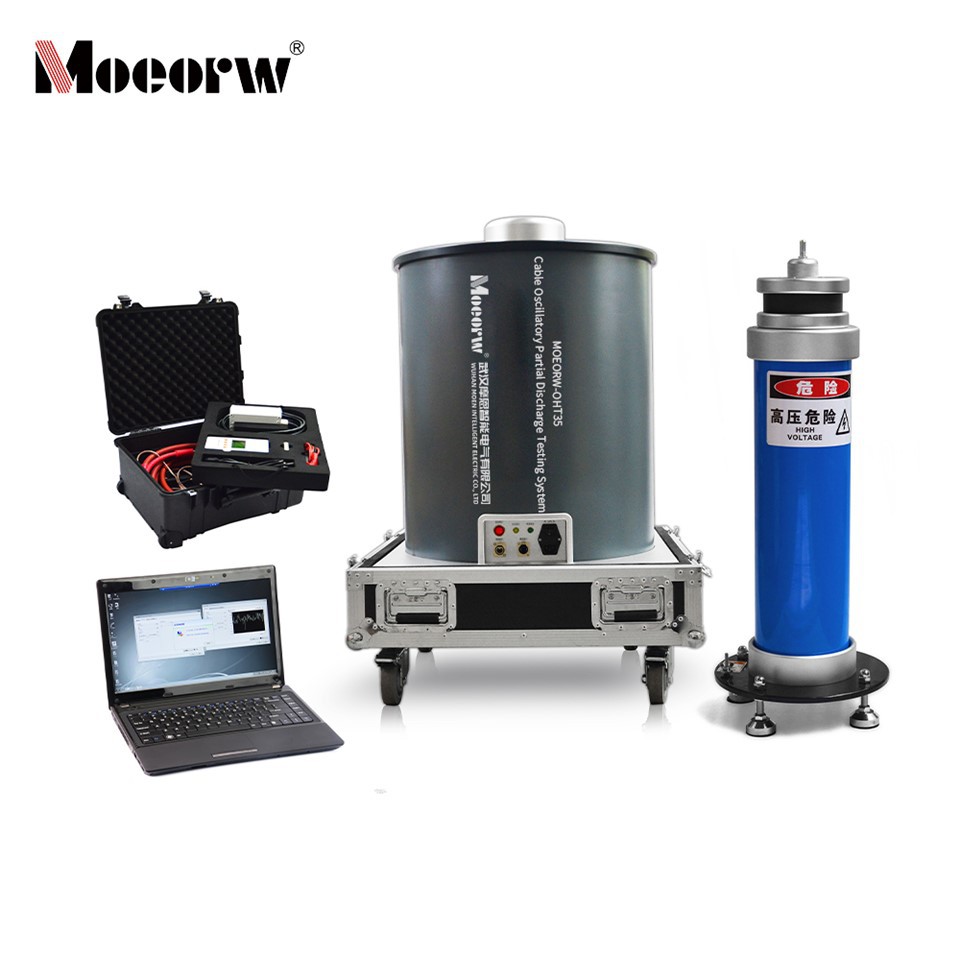
Partial discharge is a localized electrical discharge or spark that occurs within the insulation of medium-voltage (MV) and high-voltage (HV) cables when the dielectric insulation begins to deteriorate. These are tiny electric sparks — Not severe enough to bridge the insulation and cause an immediate short circuit — But they are the first indication of insulation deterioration, as stated by the National Electrical Code (NEC).
|
Technical indicators |
MOEORW- WOHT35 |
|
Low-damping oscillating power supply |
Peak voltage ≥ 60 kV, RMS voltage ≥ 42.4 kV, Oscillation current ≥ 100 A |
|
Charging time |
Less than 8 s |
|
Types of electronic switches |
IGBT |
|
Charging current |
10mA |
|
Test voltage frequency |
20Hz~800Hz |
|
Cable capacitor |
0.05μF-4μF |
|
Partial discharge level test range |
1pC-200nC |
|
Partial discharge location bandwidth |
Automatic bandwidth selection from 150kHz to 50MHz |
|
Local positioning accuracy |
1% of cable length |
|
Longest test length |
5km |
|
Tanδ test of dielectric loss angle |
0.1%~10% |
|
Total weight of the instrument |
85 kg |
|
Calibrator |
Gear settings: 1pC-200nC Rise time: No more than 30ns Pulse amplitude accuracy: 2%/5% Pulse frequency: 100Hz/200Hz Calibration capacitor: 100pF/1nF Power supply: 4 x 1.5V batteries Instrument weight: 600g |
Early Fault Detection
PD testing can identify insulation defects at an early stage, long before they develop into catastrophic failures. This includes voids, water trees, electrical trees, and manufacturing defects.
Non-Destructive Diagnostic Method
Most PD testing techniques are non-destructive, meaning they do not damage the cable insulation. The cable can often be tested without affecting its long-term performance.
High Sensitivity to Insulation Defects
PD measurement systems can detect extremely small discharge events (in pico-Coulomb range), making them highly sensitive to minor insulation weaknesses.
Condition-Based Maintenance Support
PD data helps operators move from time-based maintenance to condition-based maintenance (CBM), improving asset reliability and reducing unnecessary maintenance costs.
Capability for Defect Localization
Advanced PD systems can estimate the location of insulation defects along the cable length using signal reflection or time-difference methods.
Type of Partial Discharge Cable Testing
Offline PD Testing
Offline PD testing is performed when the cable is de-energized and isolated from the system. A controlled high-voltage source is applied to stimulate PD activity.
Online PD Testing
Online PD testing is conducted while the cable is operating under normal service voltage. Sensors detect PD signals without interrupting power supply.
Very Low Frequency (VLF) PD Testing
VLF PD testing uses very low frequency AC voltage (typically 0.1 Hz) to stress the cable insulation while detecting PD activity.
DAC (Damped AC) PD Testing
DAC testing applies a decaying oscillating waveform that simulates real operating stress conditions on cable insulation.
Tan Delta Combined PD Testing
This method combines Tan Delta (dissipation factor) measurement with PD detection to assess both global and localized insulation conditions.
Applications of Partial Discharge Cable Testing
Utility companies
Preventive maintenance of transmission networks
Industrial plants
Condition assessment of critical power cables
Renewable energy
Diagnostics for offshore wind farm cabling
Transportation
Maintenance of railway electrification systems

Test steps of Partial Discharge Cable Testing
Connect the oscillating wave generator to the cable to be measured. Generally, the output end of the oscillating wave generator is connected to the high voltage end of the cable, and the partial discharge detector is connected to the grounding end of the cable.
According to the rated voltage of the cable and test requirements, set the frequency and amplitude of the oscillation wave. In general, the frequency of the oscillating wave should be selected near the resonant frequency of the cable insulation material to improve the detection sensitivity of partial discharge.
Start the oscillating wave generator and apply oscillating wave to the cable. At this time, the phenomenon of partial discharge in the cable will be excited to produce a specific electrical signal.
Use the partial discharge detector to monitor the partial discharge signal generated in the cable. The detector can record the amplitude, frequency and duration of partial discharge in real time, and transmit the data to the computer for analysis.
Analyze the monitored partial discharge signal by oscilloscope or special software. Generally, the larger the amplitude of the partial discharge signal, the more serious the insulation defect. During the analysis process, it should be compared with historical data to determine the change of cable insulation status.

Safety: Safety operation procedures should be strictly followed during the test to ensure the safety of the operator.
Regular maintenance: The test equipment should be verified and maintained regularly to ensure its normal operation and avoid test errors caused by equipment failures.
Data recording: After each test, the test parameters and results should be recorded in detail for long-term tracking and analysis.
Environmental impact: When conducting the test, the impact of external electromagnetic interference on the test results should be avoided as far as possible, and shielding measures can be taken if necessary.
Certificates


FAQ
As one of the most professional oscillatory wave partial discharge tester manufacturers in China, we're featured by quality products and good price. Please rest assured to buy high quality oscillatory wave partial discharge tester in stock here and get quotation from our factory. Customized orders are welcome.
Partial Discharge Cable Testing, oscillatory wave partial discharge tester
