

Product Overview
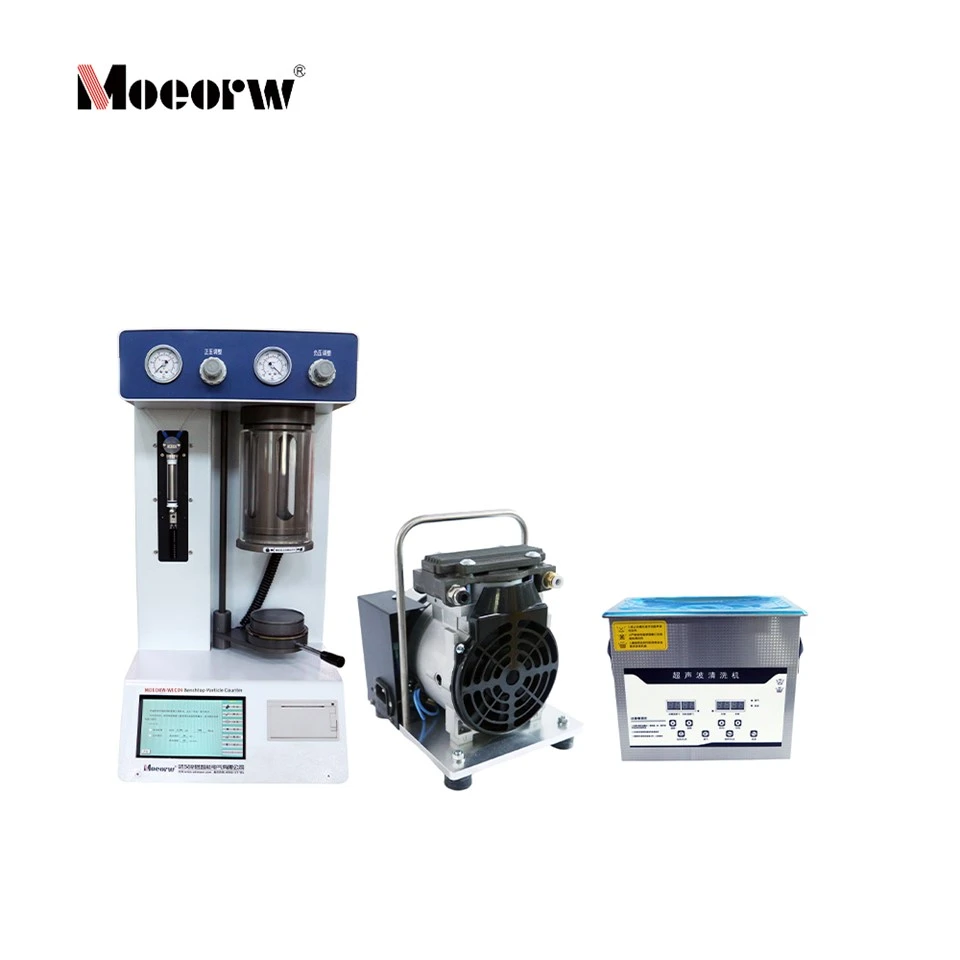
The MOEORW-WEC09 Mineral Oil Particle Counter adopts the light obscuration (shadowing) detection principle to quantify the size and quantity of insoluble solid particles suspended in liquid media. It delivers automated full-process particle contamination testing for various mineral oils and organic polymer solutions, supporting 13 mainstream international and industrial contamination grading standards. Equipped with integrated pressure control modules, high-precision injection sampling hardware, touchscreen operation, local printing and multi-channel data export functions, the instrument realizes full closed-loop workflow including sample pretreatment, automatic testing, data storage, calibration and equipment self-maintenance. It meets laboratory and on-site continuous monitoring requirements for fluid cleanliness control across multiple industrial sectors.
Technical Specifications
|
Parameter Category |
Technical Index |
|
Particle Measurement Range |
0.8 μm ~ 600 μm |
|
Particle Counting Channels |
64 configurable independent channels, customizable particle size thresholds |
|
Sampling Volume Range |
0.2 mL – 6553.5 mL |
|
Sampling Flow Rate |
5 mL/min ~ 80 mL/min |
|
Optical Resolution |
≤10% |
|
Overlap Error Limit |
24,000 particles/mL |
|
Positive Pressure Chamber Max Pressure |
0.8 MPa |
|
Negative Pressure Chamber Max Vacuum |
0.08 MPa |
|
Built-in Output Modules |
Thermal printer, RS232 serial communication port, USB data storage port |
|
Optional Detection Modules |
Viscosity testing (0–50 cSt), water activity test (0–1 aw), water content test (0–360 ppm) |
|
Power Supply |
AC 220 V ±10%, 50 Hz, rated power ≤200 W |
|
Operating Ambient Temperature |
0 ℃ ~ 60 ℃; Recommended working temperature: 10 ℃ ~ 35 ℃ |
|
Relative Humidity Requirement |
≤80% (non-condensing) |
|
Compatibility Power Grid |
AC 100–240 V wide voltage input with protective grounding |
Core Functional Features
Hardware & Structural Design
1.Integrated positive/negative pressure dual regulation cabin with independent pressure gauges and adjustment valves, supporting automatic pressure-assisted sampling for high-viscosity oil samples; emergency pressure relief button for safe pressure chamber operation.
2.High-precision motor-driven high-pressure injection pump as the core sampling unit, detachable structure for regular solvent cleaning to guarantee volumetric sampling accuracy.
3.11-inch touch control panel with full graphical menu; physical shortcut keys for rapid switching between testing, calibration, maintenance and data modules.
4.Complete fluid pipeline layout including sampling needle, testing platform, waste liquid discharge port and sewage outlet; matched air filter assembly with drain and replaceable filter components.
5.Multi-port rear panel layout: USB storage, serial communication, power interfaces for host and air pump, reset switch, observation window for air filtration unit.
Performance Capabilities
1.Light obscuration laser sensor with photodiode signal acquisition, converting particle occlusion area into linear pulse signals for accurate particle size grading and counting.
2.Three independent calibration curves (ACFTD, ISOMTD, custom curve) supporting noise test, particle size calibration and volumetric calibration to eliminate systematic testing deviation.
3.Built-in 13 international and industrial contamination grading standards, plus user-defined channel configuration with up to 50 self-set particle size detection channels.
4.Dual testing modes (automatic / manual): automatic mode executes pre-set flushing, vacuum degassing, pressure holding and sampling sequences; manual mode allows real-time pressure control, stop and exhaust operations during testing.
5.Multi-dimensional data management: local internal storage + U disk export + PC serial data upload; supports time-period data query, group data deletion, batch printing and test parameter record review.
Practical Application Value
1.Multi-level user authority management (administrator + operator): account creation, password modification and permission assignment, with a maximum of 5 registered users to standardize laboratory operation management.
2.Independent maintenance module with automatic reverse flushing and pipeline cleaning functions; configurable cleaning volume and flow rate, with optional particle concentration detection to judge cleaning completion.
3.Customizable output templates: editable sample name, batch number, inspector information; selectable print contents including particle count, average value and contamination grade.
4.System parameter adjustable: Chinese/English bilingual switching, system time calibration, stirring speed adjustment with 12 gear options for uniform particle dispersion before testing.
Application Fields
The instrument is applicable for solid particle contamination inspection of hydraulic fluids, lubricants, transformer insulating oil, turbine oil, gear oil, engine oil, aviation kerosene and water-based hydraulic media, as well as insoluble particle testing of organic liquid and polymer solutions. Target industries cover:
1.Aerospace & Aviation
2.Power Generation & Electric Utilities
3.Petroleum & Chemical Processing
4.Port & Transportation Equipment Manufacturing
5.Metallurgy & Heavy Machinery
Automobile Production & Component Testing
Working Principle
Laser Sensor Detection Principle
The liquid sample enters the glass flow cell via negative pressure siphon. Laser beams collimated by optical lenses vertically penetrate the flow cell and reach the photodiode detector. Without particles, the detector outputs a stable maximum photocurrent. When solid particles pass through the laser path, light shielding reduces incident optical power, generating negative pulse current signals. The pulse amplitude is proportional to the particle's projected cross-sectional area, enabling the system to calculate particle dimension and perform counting based on signal magnitude.
Complete Instrument Operation Logic
1.Sampling Stage: The three-way valve switches to sampling state, the high-pressure injection pump extracts oil samples through the sampling needle into the laser flow cell; particle shading signals are amplified and collected by the circuit, then transmitted to the single-chip microcomputer for particle size classification and statistical counting.
2.Discharge Stage: The three-way valve shifts to liquid drainage position, the injection pump pushes residual sample into the waste liquid container.
3.Reverse Flushing Stage: The valve remains at drainage mode, the pump draws cleaning solvent from the waste cup to backwash the flow cell, removing residual particle contaminants and preventing pipeline blockage.
FAQ
Q1: What pretreatment steps are required for oil samples before testing?
A: Seal the sample bottle tightly, perform ultrasonic vibration for minimum 1 min with ultrasonic power ≥4000 W/m² (liquid level consistent between tank and sample bottle). Shake manually for 5 min, conduct short vacuum degassing, then stand for 2–3 s before testing.
Q2: Abnormally long sampling time and unstable counting data, what is the root cause?
A: The glass flow cell is blocked by viscous oil or large particles. Solve via reverse flushing, alternating air-liquid circulation cleaning or dedicated solvent pipeline cleaning as described in the maintenance module.
Q3: The printed report shows blank content with no particle data output
A: Confirm the thermal paper is installed with the heat-sensitive coating facing upward; ensure the paper extends out of the outlet and is fully pressed by the rubber roller, then re-close the printer cover.
Q4: How often is calibration required, and what three calibration items are mandatory?
A: Regular calibration includes noise testing, particle size calibration and volumetric calibration. Volume calibration uses 5 mL fixed sampling volume with gravimetric weighing method; particle size calibration uses standard calibration liquid to adjust threshold voltage for curve correction.
Q5: Pressure chamber cannot build stable pressure during testing
A: Verify tight connection of positive/negative pressure air tubes on the rear panel; drain accumulated water inside the air filtration assembly through the observation window; check whether the filter block of the air drying unit is clogged and replace if necessary.
Q6: Login prompt pops up and all testing functions are locked
A: The instrument prohibits all operations without valid user login. Log in with admin (initial password 0) for full authority, or operator accounts for limited testing permissions.
Hot Tags: benchtop oil particle counter, China benchtop oil particle counter manufacturers, factory