


Transformer Turns Ratio (TTR)Tester
Original Manufacturer TTR Testing Equipment: Fully Compliant with Global Power Standards

01
15+
Years of R&D Experience

02
6000+
Completed Project Cases

03
CE/ISO
Full Export Certifications

04
98.5%
Project Acceptance Rate
-
![Transformer Turns Ratio(TTR)and Group Tester]() Transformer Turns Ratio(TTR)and Group TesterSix-Channel Sync Sampling – 3-Phase Done in One TestFully Solid-State, No Relays – Maintenance-FreeHeterodyne Frequency – Immune to On-Site Interference
Transformer Turns Ratio(TTR)and Group TesterSix-Channel Sync Sampling – 3-Phase Done in One TestFully Solid-State, No Relays – Maintenance-FreeHeterodyne Frequency – Immune to On-Site Interference -
![Handheld Turns Ratio Group Tester]() Handheld Turns Ratio Group TesterThis handheld model is lightweight, durable, and waterproof, perfect for field and outdoor work. It supports three-phase simultaneous measurement and automatic group identification, saving time and
Handheld Turns Ratio Group TesterThis handheld model is lightweight, durable, and waterproof, perfect for field and outdoor work. It supports three-phase simultaneous measurement and automatic group identification, saving time and -
![Automatic Transformer Turns Ratio Group Tester]() Automatic Transformer Turns Ratio Group TesterThis benchtop tester is highly practical and easy to operate. It supports one-time wiring to complete turns ratio, group, polarity, and angle difference testing. It has built-in printing, USB
Automatic Transformer Turns Ratio Group TesterThis benchtop tester is highly practical and easy to operate. It supports one-time wiring to complete turns ratio, group, polarity, and angle difference testing. It has built-in printing, USB -
![Transformer DC Resistance And Turns Ratio Integrated Tester]() Transformer DC Resistance And Turns Ratio Integrated TesterOne-time wiring completes six-phase tests, doubling your efficiency. Supports temperature conversion and automatic connection group recognition, suitable for special transformers. Multiple safety
Transformer DC Resistance And Turns Ratio Integrated TesterOne-time wiring completes six-phase tests, doubling your efficiency. Supports temperature conversion and automatic connection group recognition, suitable for special transformers. Multiple safety -
![Transformer DC Resistance & Ratio Tester]() Transformer DC Resistance & Ratio TesterAll-in-one design integrates DC resistance and transformation ratio tests, saving wiring time and labor. 7-inch touchscreen makes operation simple and fast. Built-in print, storage and USB export
Transformer DC Resistance & Ratio TesterAll-in-one design integrates DC resistance and transformation ratio tests, saving wiring time and labor. 7-inch touchscreen makes operation simple and fast. Built-in print, storage and USB export -
![Transformer Turns Ratio Verification Device]() Transformer Turns Ratio Verification DeviceThe MOEORW-WBC91 Transformer Turns Ratio Verification Device is designed for power calibration agencies and power users, and is a high-precision transformer turns ratio verification device.It focuses
Transformer Turns Ratio Verification DeviceThe MOEORW-WBC91 Transformer Turns Ratio Verification Device is designed for power calibration agencies and power users, and is a high-precision transformer turns ratio verification device.It focuses -
![Three Phase Transformer Turns Ratio Tester]() Three Phase Transformer Turns Ratio TesterThe MOEORW-W4506 is a three-phase transformer turns ratio group tester designed for power companies, transformer manufacturers, and maintenance personnel .It features fully automatic measurement,
Three Phase Transformer Turns Ratio TesterThe MOEORW-W4506 is a three-phase transformer turns ratio group tester designed for power companies, transformer manufacturers, and maintenance personnel .It features fully automatic measurement, -
![Instrument Transformer Winding Deformation Tester]() Instrument Transformer Winding Deformation TesterThe MERB-WII Transformer Winding Deformation Tester employs the FRA method, accommodates transformers ranging from 63kV to 500kV, supports multiple connection types for measurement, delivers precise
Instrument Transformer Winding Deformation TesterThe MERB-WII Transformer Winding Deformation Tester employs the FRA method, accommodates transformers ranging from 63kV to 500kV, supports multiple connection types for measurement, delivers precise -
![Special Transformer Turns Ratio Tester]() Special Transformer Turns Ratio TesterMEBC-WYT2 Handheld Specialized Transformer Ratio and Group Tester supports full blind testing and multiple transformer types. It delivers precise and reliable three-phase true measurement and phase
Special Transformer Turns Ratio TesterMEBC-WYT2 Handheld Specialized Transformer Ratio and Group Tester supports full blind testing and multiple transformer types. It delivers precise and reliable three-phase true measurement and phase -
![Fully Automatic Transformer Ratio Tester]() Fully Automatic Transformer Ratio TesterThe MEBC-WE Fully Automatic Turns Ratio and Connection Group Tester employs a lithium battery along with an adaptive 220V AC power supply. With a large screen of high definition and a thermal
Fully Automatic Transformer Ratio TesterThe MEBC-WE Fully Automatic Turns Ratio and Connection Group Tester employs a lithium battery along with an adaptive 220V AC power supply. With a large screen of high definition and a thermal -
![Transformer Turns Ratio Group Tester]() Transformer Turns Ratio Group TesterMEBC-WII Fully Automatic Turns Ratio and Tap Position Tester is specifically designed for the power industry to address the pain points of traditional measurement methods. It automatically completes
Transformer Turns Ratio Group TesterMEBC-WII Fully Automatic Turns Ratio and Tap Position Tester is specifically designed for the power industry to address the pain points of traditional measurement methods. It automatically completes -
![Transformer Turn Ratio Meter]() Transformer Turn Ratio MeterEssential for transformer production, commissioning, and maintenance! The MEBC-WZ Handheld Turns Ratio and Group Tester supports single-phase/three-phase testing with easy storage and export.
Transformer Turn Ratio MeterEssential for transformer production, commissioning, and maintenance! The MEBC-WZ Handheld Turns Ratio and Group Tester supports single-phase/three-phase testing with easy storage and export.


🧱 Module 1: Introduction & Definition – What is a Transformer Turns Ratio (TTR) Test?
Why Must You Perform Transformer Turns Ratio and Connection Group Testing?
The transformer turns ratio (TTR) represents the ratio of high-voltage to low-voltage winding turns, serving as a mandatory routine test during manufacturing, commissioning, and maintenance. Deviations can cause unstable output, increased losses, or system failure.
Key objectives include:
- Verifying Design & Tap Changer Specifications: Ensuring transformation aligns with design and nameplate data.
- Diagnosing Incipient Internal Faults: Detecting turn-to-turn short circuits, open circuits, and other latent winding defects.
- Determining Parallel Operation Conditions: Checking three-phase imbalance to prevent damaging circulating currents during parallel operation.
- Evaluating Winding Structural Deformation: Measuring ratio and phase angle shifts to assess deformation from short-circuit impacts.
⚡ Module 2: Key Technical Features
Wuhan Moen’s next-generation transformer turns ratio testers deliver industrial-grade performance:
- Ultra-Wide Measurement Range: Supports broad ratios for various power transformers.
- Ultra-Fast Synchronous Sampling: Completes three-phase measurements efficiently with multi-channel sampling.
- Ultimate Accuracy & Resolution: Delivers high precision and fine resolution for ratio testing.
- Solid-State Architecture: Features a reliable design for extended durability.
- Digital Anti-Interference: Equipped with advanced filters to handle electromagnetic interference.
🏭 Module 3: Typical Application Scenarios – All-Industry Coverage & Universal Adaptability
Our transformer turns ratio and connection group testers provide robust diagnostic power across mission-critical sectors including utility grids, manufacturing, and renewables.
- Power Generation & Utility Grids: Routine maintenance, preventive testing, and commissioning validation for main power transformers.
- Transformer Manufacturing & Repair Shops: Final factory acceptance testing (FAT), coil inspections, and compliance checks post-overhaul.
- Renewable Energy Systems: Rapid, on-site field diagnostics of step-up transformers in solar and wind facilities.
- Heavy Industry & Specialized Manufacturing: Ratio and phase shift measurements for heavy-duty special transformers in smelting and chemical plants.
- Transit, Data Centers & Critical Infrastructure: Ensuring power reliability for rail traction, airports, and hyperscale data centers.
🏆 Module 4: Our Advantages – Why Choose Wuhan Moen?
Wuhan Moen stands as a premier authority in electrical engineering, providing reliable testing technologies and unparalleled service to global power markets.
- 30+ Years of Manufacturing Heritage: Deeply rooted in high-voltage testing since 1992, operating an 8,000 m² state-of-the-art R&D and production facility.
- International Standards & Certifications: Fully certified under ISO 9001 (Quality Management), ISO 45001 (Health & Safety), and ISO 14001 (Environmental Management).
- Global Customization Capabilities: Backed by an engineering team capable of designing custom Class 0.1 verification devices for 50Hz/60Hz grids and non-standard transformers.
- End-to-End Service Assurance: Providing continuous support covering technical consultation, training, and certified annual calibration with full traceability.
📦 Module 5: Core Product Portfolio – Multi-Scenario Selection Guide


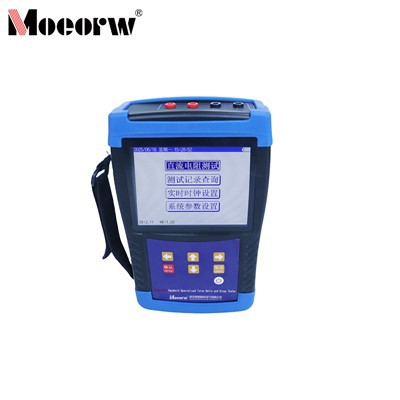
1. Handheld Transformer Turns Ratio Tester
Key Tags: Lightweight & Portable | Built-in Lithium Battery | Waterproof & Shockproof
Overview: Weighing only 1.8 kg, this compact device is purpose-built for outdoor, field, and unpowered sites, delivering simultaneous three-phase measurement.
2. Automatic Three-Phase TTR & Connection Group Tester
Key Tags: Fully Automatic Benchtop | HD Touchscreen | On-site Data Printing
Overview: Complete turns ratio, connection group, polarity, and tap position analysis via one-time wiring. Supports USB data export and thermal printing.
3. Integrated Transformer DC Resistance & Turns Ratio Tester
Key Tags: Multi-Functional Integration | Reduced Wiring Time | Maximum Efficiency
Overview: Combines DC winding resistance and turns ratio diagnostics into a single unit. Completes six-phase testing with one setup to minimize maintenance downtime.
4. Special Transformer Turns Ratio Tester
Key Tags: Non-Standard Transformer Testing | True Three-Phase Measurement | Phase Angle Analysis
Overview: Specifically engineered for non-standard configurations including Z-type, balanced, and rectifier transformers to deliver precise ratio calculations and phase angle verification.
FAQ
Q: TTR Abnormalities as a Diagnostic Tool: What Do Ratio Deviations Mean?
A: When a TTR tester detects a ratio error that exceeds international standards (typically >0.5%), it often serves as an early warning for specific internal transformer faults: Turn-to-Turn Short Circuits: A localized short circuit within a winding alters the effective number of turns, causing an immediate, noticeable shift in the turns ratio. Tap Changer Misalignment or Faults: Incorrect contact pressure, mechanical wear, or wiring errors in the tap changer will manifest as abnormal ratio readings on specific tap positions. Winding Deformation: Severe mechanical stresses from external short-circuit faults can physically displace or deform the windings, altering the magnetic flux linkage and leading to ratio and phase angle anomalies.
Q: Why is phase angle (angular displacement) measurement critical during a TTR test?
A: While standard ratios measure voltage amplitude, the phase angle detects minute structural or magnetic variances. Measuring the phase angle allows engineers to verify connection groups (e.g., Dyn11, Ynd11) and catch phase shifts caused by winding deformation that ratio metrics alone might miss.
Q: How does a TTR tester ensure reliable readings in high-interference substation environments?
A: Modern TTR testers utilize advanced variable-frequency digital filtering and synchronous sampling technologies. Instead of relying on standard grid frequencies, the internal source generates distinct frequencies to completely isolate and eliminate electromagnetic interference (EMI) from nearby live high-voltage equipment.
Q: Can a standard TTR tester be used for Z-type, rectifier, or traction transformers?
A: No. Standard TTR meters use single-phase or basic symmetric three-phase vector math. Specialized configurations like Z-type, balanced, or phase-shifting rectifier transformers feature intricate internal phase displacements. These require a dedicated analyzer, such as our MEBC-WYT2, which performs true three-phase phase angle and ratio verification.
As one of the most professional transformer turns ratio tester manufacturers in China, we're featured by quality products and good price. Please rest assured to buy high quality transformer turns ratio tester in stock here and get quotation from our factory. Customized orders are welcome.
Transformer Turn Ratio Meter, Transformer Winding Deformation Tester, Transformer On load Switch Tester
