

Product Overview
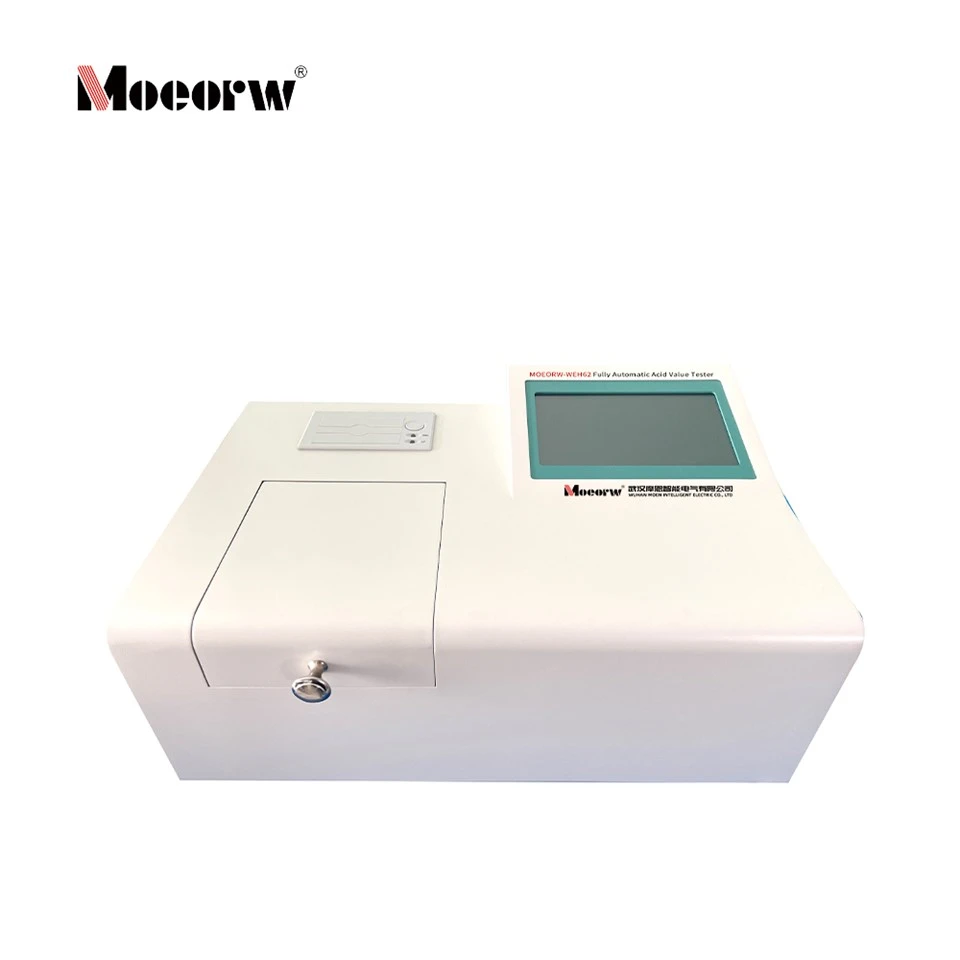
The MOEORW-WEH62 fully automatic oil acid value tester is a laboratory-dedicated analytical instrument engineered for rapid acid value quantification of oil samples. Equipped with a 32-bit high-performance ARM microprocessor and HDD technology, the unit supports simultaneous testing of up to six samples under normal or harsh field operating environments.
Adopting neutralization titration detection principle, the equipment automates sample cup rotation, reagent titration, endpoint judgment, data printing and wireless remote control. The fully enclosed reagent delivery system isolates operators from direct contact with toxic organic solvents and chemical reagents, delivering outstanding environmental protection and operational safety. It is widely deployed in military, electric power and petroleum laboratory testing scenarios.
Technical Specifications
|
Item |
Parameter |
|
Display |
High-definition color touch screen |
|
Measurement Range |
0.0001~5.000 mgKOH/g |
|
Resolution |
0.0001 mgKOH/g |
|
Measurement Accuracy |
0.001~0.1 mgKOH/g: ±0.01 mgKOH/g0.1~0.5 mgKOH/g: ±0.03 mgKOH/g0.5~1.0 mgKOH/g: ±0.07 mgKOH/g1.0~2.0 mgKOH/g: ±0.10 mgKOH/g |
|
Detection Method |
Chemical Neutralization Titration |
|
Maximum Sample Quantity |
6 positions |
|
Power Supply |
AC220V ±10%, 50Hz |
|
Operating Ambient Temperature |
5℃ ~ 50℃ |
|
Relative Humidity Requirement |
≤75% RH |
|
Power Consumption |
60W |
|
Printing Module |
Thermal printer (40 characters per line) |
|
Overall Dimension (L×W×H) |
440×280×200 mm |
|
Net Weight |
10 KG |
Core Functional Features
1.Strong EMC Hardware Design The instrument complies with IEC801 electromagnetic compatibility standards, with built-in anti-interference circuits to stabilize operation against grid voltage fluctuations and ambient electromagnetic interference, guaranteeing consistent test data stability in complex laboratory environments.
2.Humanized Touch Operation System Full-color touch screen with visualized dedicated operation interfaces for test setup, pipeline exhaust, self-inspection, data recording and result display. Agitated stirring speed can be dynamically adjusted during extraction according to sample viscosity to optimize extraction efficiency.
3.Closed Reagent Supply Safety Architecture Special sealed reagent bottles store extraction and neutralization solutions without air exposure. A concentrated alkali liquid gas washing bottle eliminates CO₂ interference to neutralization liquid titration concentration. Operators avoid direct physical contact with corrosive and volatile chemical reagents to reduce occupational chemical hazards.
4.Full-Automatic One-Click Testing Workflow Supports batch multi-sample synchronous analysis; automatic pipeline exhaust, multi-module self-inspection (positioning, light source, stirring), full-process unattended titration, automatic endpoint identification, real-time result display and thermal print output. Built-in data storage module enables historical record query and reprinting.
Wireless Remote Control Function Integrated wireless transmission module allows remote parameter configuration and test execution, improving laboratory testing efficiency and realizing centralized equipment management.
Product Structure
1.Peristaltic Pumps: Dual independent pumps for extraction liquid and neutralization liquid delivery, equipped with detachable pump clamps to prevent hose permanent deformation
2.Thermal Printer: Embedded front printing unit for real-time test report output
3.Power Socket & Fuse: Overcurrent protection circuit to secure power supply stability
4.Color Touch Display: Central human-machine interaction component
5.Main Power Switch: Master power control for the whole device
6.Protective Cover: Dust-proof sealing cover for sample testing chamber
7.Gas Washing Bottle: Internal filling of concentrated alkali liquid to purify neutralization liquid balance gas
Standard Operating & Daily Maintenance Guidelines
Standard Operation Procedures
1.Fix the instrument on a horizontal stable workbench, install extraction and neutralization liquid pump hoses into corresponding peristaltic pump clamps and lock in place.
2.Replace original reagent bottle caps with supplied stainless steel pipette caps, insert suction tubes into extraction liquid, neutralization liquid and concentrated alkali washing bottle respectively.
3.Connect grounded AC220V power supply; place 1–5g oil sample with magnetic stirrer into sample cups and load cups into designated positions. Dark-colored oil samples require smaller weighing mass.
4.Power on the unit; execute pipeline exhaust function to eliminate air bubbles inside delivery tubes, and complete light source, stirring and positioning self-inspection.
5.Enter setup interface to select active cup positions and input corresponding sample weights; adjust titration speed (fast mode for high acid value samples) and printer switch status.
6.Initiate automatic testing; the system completes extraction, stirring, neutralization titration and endpoint judgment automatically. After test completion, view or print acid value results on the display.
7.Post-test cleaning: Submerge neutralization liquid suction tube into anhydrous ethanol, run neutralization pipeline exhaust to flush internal tubes; exhaust residual extraction liquid from extraction pipelines. Lift all peristaltic pump clamps after cleaning.
8.Power off the equipment, remove and clean sample cups for standby storage.
Daily Maintenance Requirements
1.Release extraction and neutralization pump clamps after every test to avoid long-term hose compression deformation and delivery inaccuracy.
2.Flush neutralization pipelines completely with anhydrous ethanol after each use to prevent sediment blockage of micro titration nozzles.
3.Replace aging, inelastic delivery hoses in a timely manner to avoid reagent leakage and test deviation.
4.Ensure reliable ground connection of the power socket at all times to eliminate electrostatic interference and safety risks.
FAQ
Q1: Transmittance reading displays zero during neutralization titration, how to resolve?
A1: Reduce sample injection volume and restart the test to avoid excessive sample concentration blocking light detection.
Q2: Test results show obvious deviation after long-term continuous operation
A2: 1) Execute pipeline exhaust to remove residual air bubbles; 2) Check whether the concentrated alkali liquid in the gas washing bottle fails and replace it; 3) Verify pump hose elasticity and replace deformed tubes if necessary.
Q3: Stirring vortex blocks the built-in light source during neutralization, affecting endpoint judgment
A3: Lower the stirring speed of neutralization procedure to eliminate light occlusion from liquid vortex.
Q4: Reagent pipelines are clogged after instrument idle for several days
A4: Flush all pipelines with anhydrous ethanol via exhaust function; release pump clamps during long-term shutdown to protect hoses.
Q5: Historical test records cannot be printed normally
A5: Check thermal printing paper installation status; confirm the printer switch is set to "ON" in the setup interface before reprinting records.
Hot Tags: fully automatic six-cell oil acid value tester, China fully automatic six-cell oil acid value tester manufacturers, factory