Oil Flash Point Tester

Send Inquiry
Oil Flash Point Tester
Details
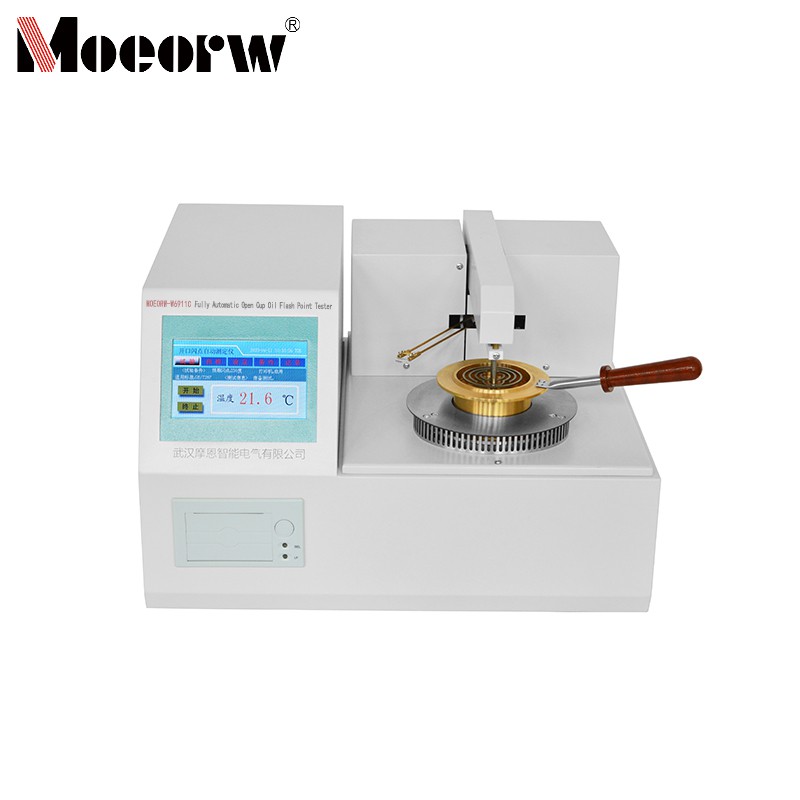
MOEORW-W6911C Fully Automatic Open Cup Flash Point Tester measures the open cup flash point and fire point of petroleum products. It features electric ignition without gas and complies with multiple standards. With high precision and strong automation, it stores up to 1,000 data points and is suitable for petroleum, chemical, and other industries.
Category
Oil Test Equipment
Share to
Description

Fully Automatic Open Cup Flash Point Tester


Product Introduction


Open Cup Flash Point Tester, designed to determine the open cup flash point and ignition point of petroleum products. The instrument employs an electric ignition method, eliminating the need for any combustible gases, and fully complies with the requirements of ASTM D92 (GB3536-2008) and GB267-88. It incorporates multiple cutting-edge technologies, including an ARM series high-performance microprocessor, EEPROM (capable of storing thousands of data records), a color LCD display with touchscreen, and PID self-tuning.


Product Parameter (specification)


(1) Measurement Range

Ambient temperature to 400°C

(2) Detection Type

Open cup flash point or fire point

(3) Temperature Detection

Platinum resistance thermometer

(4) Accuracy

±1°C

(5) Repeatability

Complies with GB3536-2008 (ASTM D92), GB/T 267-88

(6) Display

Color LCD

(7) Data Storage

Stores up to 1000 test results

(8) Ignition Method

Electric ignition

(9) Cooling Method

Forced air cooling

(10) Printer

Dot matrix thermal printer

(11) Self-test Function

Lifts, sweeps, prints, etc.

(12) Power Consumption

≤600VA

(13) Power Supply

AC 220V ±11V, Frequency 50Hz ±2.5Hz

(14) Ambient Temperature

10~35℃

(15) Ambient Humidity

≤90%

(16) Weight

Approx. 17kg


Product feature and application


★ Highly functional. Capable of dual-purpose operation to simultaneously detect flash point and ignition point, with test results printed. Features an internal clock chip that automatically displays current date and time, maintaining settings during power loss.

★ High Accuracy. Temperature deviation controlled within ±1.5°C, with 0.1°C resolution.

★ Excellent Repeatability. When testing conditions comply with GB3536 (ASTM D92) or GB/T 267-88, consecutive tests on the same sample yield flash point values differing by ≤4°C.

★High automation. Fully automates the testing process, including automatic cooling and automated information prompts.

The Open Cup Flash Point Tester aligns with the highest global standards in functionality and performance. It serves as a specialized instrument for petroleum, power, chemical, and commodity inspection industries, replacing imported products.


Prodection details


Petrochemicals, energy, transportation, power generation, environmental protection, and quality inspection are just a few of the industries that use the Open Cup Flash Point Tester, a specialized tool for precisely determining the flash point of flammable liquids in open conditions. It encompasses every step of the process, from product quality testing to manufacturing process control and raw material approval.


Company Qualifications


FAQ

1)How does the fully automatic open cup flash point tester work?

The instrument follows the heating curve specified in GB/T3536-2008 (ASTM D92) and GB/T 267-88. A CPU-controlled heater warms the sample, while a color LCD display shows status, temperature, and setpoints. As the sample approaches its flash point, the CPU triggers the electric ignition system for automatic ignition and sweeping. Upon detecting the flash point, the instrument automatically locks the value. Simultaneously, heating ceases automatically and the heater undergoes forced air cooling.

2)What is the testing process for an oil flash point tester?

1. Select the test standard method:
In the "Conditions" interface, choose the standard method for the test and set the printer status and detection type-flash point or fire point.
2. Set the expected flash point and atmospheric pressure value:
In the "Settings" interface, click "Confirm" after "Expected Flash Point" to set the expected flash point value; click 'Confirm' after "Atmospheric Pressure" and set the pressure value according to the local atmospheric pressure.
3. Pour the sample into the sample cup:
- Samples with a flash point below 210°C: Fill to the upper mark.
- Samples with a flash point above 210°C: Fill to the lower mark.
Then place the sample cup on the heater.
4. On the "Test" interface:
Click "Start" to automatically lower the lifting rod into the sample cup and begin heating. When testing the flash point, upon reaching the flash point, the lifting rod automatically raises, displays the open flash point value of the tested sample, and prints/saves the test results. When testing the fire point, after the flash point is reached, the instrument automatically saves and records the flash point value while continuing the test. When combustion occurs in the sample, it saves and displays the fire point value, printing both flash point and fire point results together.
5.Remove the test cup. After the test cup and its heater have cooled, the next test may be conducted.

3)Is the oil flash point tester easy to maintain ?

1. Prolonged use of the spark sensor may cause oil residue buildup, which affects detection accuracy. Clean the sensor regularly with gasoline or petroleum ether, exercising extreme caution during cleaning.
2. If the buzzer emits a continuous tone upon startup, shut down the device and inspect the detection ring sensor for short circuits. Check the detection ring surface for oil residue, fibrous contaminants, or other foreign objects. Resolve the issue before restarting the test.
3. Two causes may explain the ignition lift-off during the first sweep of the test lead:
(1) If a flash fire actually occurs during the first sweep, this indicates the preset temperature is too high. Lower the set temperature value and retest.
(2) If the probe lifts without sparking during the first sweep, this also indicates an excessively high preset temperature. In this case, inspect the detection ring surface for cleanliness. Check for thread-like fibers causing a short circuit, or whether the detection ring is loose and causing a short circuit. Only proceed with the test again after addressing these issues.


Hot Tags: oil flash point tester, China oil flash point tester manufacturers, factory, Oil Acid Tester, Oil Filtration Machine, Oil Flash Point Tester, Oil Tension Tester, oil test equipment, Oil Trace Moisture Tester

Send Inquiry