
Product Introduction
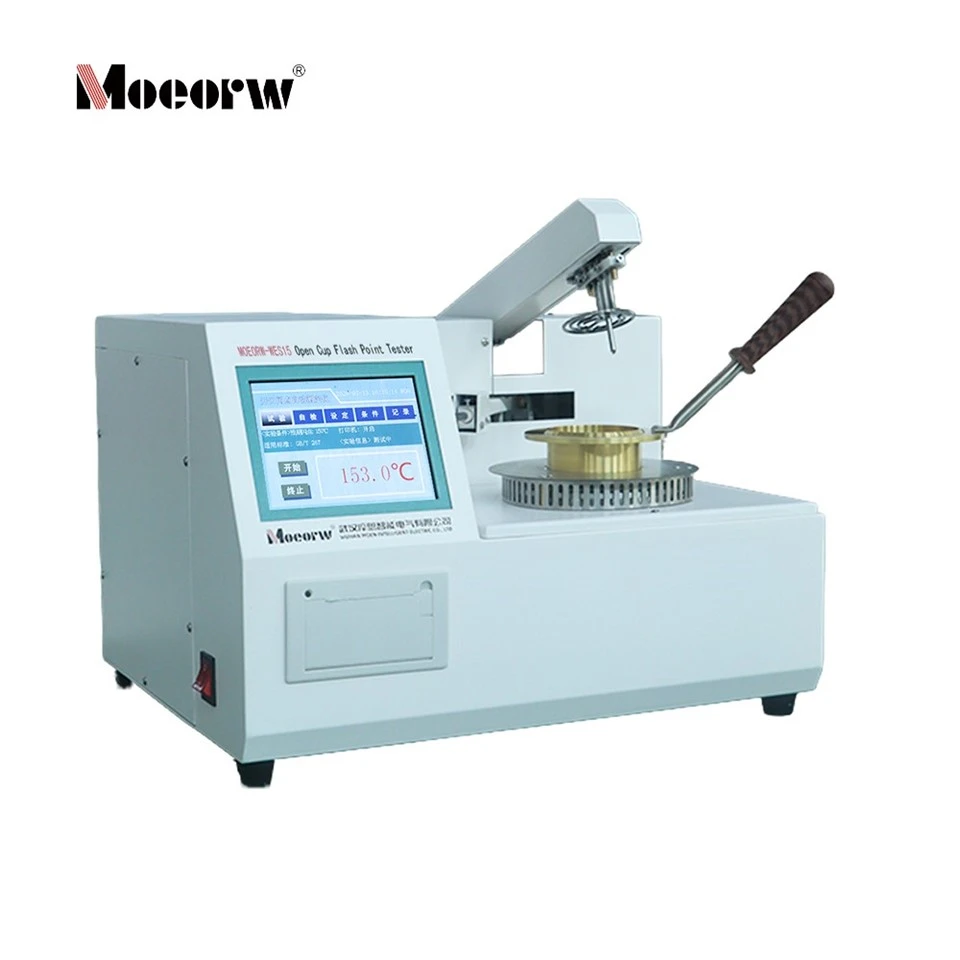
MOEORW‑WES15 automated open‑cup flash‑point analyzer represents locally‑developed import‑substitute oil‑testing hardware, built to quantify open‑cup flash‑point as well as fire‑point parameters for lubricants, diesel fractions and diverse chemical solvents. Alternative naming variants include Cleveland open‑cup flash‑point apparatus and power‑plant lubricant flash‑point measuring unit. This analyzer satisfies GB3536‑2008, GB/T 267‑88 and ASTM D92 global assessment criteria. It acts as core lab hardware for refineries, power‑plant labs, chemical manufacturing complexes, third‑party verification organizations and petroleum‑product traders, also suitable for small‑scale laboratories and processing factories purchasing individual instruments. Driven by high‑performance ARM microprocessor plus PID auto‑tuning thermal regulation, it employs silicon‑nitride non‑gas electric igniter paired with color touch‑screen human‑machine interface. One single device accomplishes both flash‑point and fire‑point determination. No combustible gas supply (LPG or alcohol fuel) is needed, removing lab‑safety risks related with gas‑cylinder storage. Automated workflow minimizes manual involvement; measurement outputs maintain stability even under heavy continuous‑duty cycles with low failure occurrence, suiting both distributor bulk stock‑keeping and factory daily quality‑control operations.
Key Product Advantages
Switchable dual‑standard modes, dual‑parameter measurement for flash‑point plus fire‑point to lower procurement overhead Pre‑installed program sets for GB267‑88 and GB3536‑2008 allow rapid standard switching, supporting two distinct measurement modes. A dedicated high‑frequency ignition profile (triggered every 1℃ temperature increment) is prepared for low‑flash‑point light‑oil specimens. For distributors: stocking this single model covers client requirements from lubricant, fuel‑oil and chemical‑solvent industries, reducing inventory pressure. For end‑user factories: one instrument fulfills two quality‑control metrics and optimizes laboratory hardware budget allocation. Small‑scale labs and individual operators gain broad test compatibility without investing in multiple supporting devices.
High‑fidelity, repeatable measurement outputs delivering legally‑admissible inspection results and reducing post‑sales complaints Measuring range 40℃‑400℃, adopting precision platinum‑resistance temperature transducer; accuracy reaches ±1℃ alongside 0.1℃ temperature resolution. Within standardized lab surroundings, repeated testing over identical specimen yields flash‑point deviation ≤4℃, complying fully with error tolerance defined by official standards. Third‑party inspection agencies, power utilities and petrochemical facilities impose strict precision prerequisites; measurement outputs from this analyzer meet regulatory requirements and generate valid official inspection documentation. Distributors observe fewer complaints caused by inaccurate readings and improved client repurchase tendency. Individual‑user labs obtain trustworthy datasets for internal QC and customer acceptance evaluation without measurement offset.
Silicon‑nitride gas‑free electric ignition expands applicable‑site coverage and creates differentiated competitive edges for resellers Silicon‑nitride igniter requires no gas‑supply port, eliminating combustible gas consumption throughout measurement. A built‑in forced‑air cooling system is integrated. Many power‑station facilities and chemical industrial zones prohibit gas cylinders inside closed lab premises, imposing operational limits for conventional gas‑fueled Cleveland open‑cup devices. The WES15 model circumvents such restrictions. Distributors may secure large‑volume tender orders leveraging this safety‑oriented advantage. Small‑size laboratories avoid purchasing and storing flammable gas sources, lowering fire‑accident potential in day‑to‑day lab routines.
Unattended automatic test workflow cuts enterprise human‑resource expenditure Central processor governs heating curve strictly aligned with standard specifications, driving motorized lifting assembly plus cyclic ignition‑sweeping sequences. Upon detecting flash occurrence or sustained combustion (fire‑point event), hardware automatically freezes temperature reading, halts heating and activates forced‑air cooling. Comprehensive self‑diagnosis function covers lifting actuator, igniter unit, cooling fan, sweep assembly and printing component with single‑click trigger. Within large factory inspection workshops, one technician can supervise multiple analyzers simultaneously, lowering labor costs - this constitutes key merit for bulk procurement projects. Embedded diagnosis quickly isolates faulty components and enhances distributors' commissioning and field‑maintenance efficiency. Individual‑site operators complete whole measurement cycles without continuous monitoring; brief training enables personnel without specialized background to operate correctly.
1000‑set onboard log storage plus multi‑path data export satisfies long‑term audit traceability for safety‑supervision authorities EEPROM memory preserves up to 1000 full test datasets; records survive power‑supply interruption. Flash‑point entries are tagged marker "S", fire‑point results marked "R". The unit integrates dot‑matrix thermal printer and supports wireless PC‑direct data transfer. Real‑time clock chip appends timestamp including year‑month‑day‑hour‑minute‑second for every logged measurement. Chemical, power‑sector and inspection‑industry workflows demand long‑term data archiving for safety compliance, environmental auditing and client assessment purposes. Bulk‑purchase customers avoid investing in separate recording hardware to realize all‑in‑one traceability workflows. This functional merit can be highlighted within bidding tender documents to lift win‑bid probability. End‑users obtain auto‑saved records printable whenever needed, removing manual log‑book entry work and simplifying inspection‑report compilation.
Graphic touch‑screen HMI lowers learning barriers, facilitating nationwide product distribution Color LCD touch panel provides five independent operational screens: test runtime view, self‑diagnosis panel, parameter configuration, condition setup and historical‑record repository. Pop‑up numeric keypad lets operators configure expected flash‑point threshold, local barometric‑pressure correction offset, system clock, printer activation toggle and applicable test‑standard selection freely. New‑recruit inspectors from manufacturing plants achieve proficiency after short orientation, reducing corporate training expenses. Barometric‑pressure compensation neutralizes measurement deviation induced by altitude variance, making the instrument suitable for resellers covering geographically‑diverse domestic market regions. Stand‑alone buyers complete equipment setup and full measurement cycles relying on supplied hard‑copy manuals, without scheduling on‑site technical‑training visits.
Robust industrial‑grade hardware tolerating round‑the‑clock high‑intensity measurement workloads Total power consumption ≤600VA, designed for AC220V±11V /50Hz industrial mains supply. Integrated cabinet‑style construction yields net weight approximately 17 kg. Permissible ambient conditions: surrounding temperature range 10‑35℃, relative humidity ≤90%. Platinum‑resistance temperature probe resists corrosive airborne contaminants. Refineries and large‑scale inspection workshops run cyclic 24‑hour testing with minimal failure rate, helping distributors sustain positive end‑user reputation. Standard‑spec mains compatibility removes mandatory voltage‑stabilizer requirements for factory‑site deployment. For small‑batch daily‑testing scenarios, solid mechanical construction maintains stable performance over multi‑year service cycles with limited hardware degradation.
Product Parameter (specification)
|
Parameter Item |
Detailed Specification |
|
Full Product Name |
MOEORW-WES15 Automatic Open Flash Point Tester (Open Flash Point Tester, Oil Open Flash Point Detector, Petroleum Product Flash & Fire Point Tester, Automatic Cleveland Open Cup Flash Point Apparatus, Power Lubricating Oil Flash Point Tester, Chemical Raw Material Fire Point Testing Equipment) |
|
Test Temperature Range |
40℃~400℃ |
|
Temperature Sensor |
High-precision Platinum Resistance |
|
Temperature Accuracy |
±1℃, Temperature Resolution: 0.1℃ |
|
Compliant Standards |
GB3536-2008, GB/T 267-88, ASTM D92 |
|
Ignition Method |
Silicon nitride gas-free electric ignition |
|
Cooling Mode |
Fully automatic forced air cooling |
|
Data Storage Capacity |
1000 groups of test data, permanently reserved after power off |
|
Data Output |
Built-in dot-matrix thermal printer, wireless transmission to PC |
|
Complete Self-Check Items |
One-click self-check for lifting rod, igniter, fan, sweeping rod and printer |
|
Total Power |
≤600VA |
|
Power Supply |
AC220V±11V, 50Hz±2.5Hz |
|
Operating Environment |
Ambient temperature:10~35℃, Ambient humidity ≤90% |
|
Net Weight |
Approx.17kg |
Standard Operating Procedures
Instrument Placement: Install detector on level workbench; shield unit from direct sunlight and strong cross‑airflow. Fume‑hood installation is recommended. Deactivate exhaust blower throughout measurement procedure to prevent airflow‑caused readout distortion.
Parameter Pre‑configuration: Navigate toward Condition screen, pick applicable national‑standard protocol, toggle flash‑point/fire‑point measurement mode and enable/disable printer output. Move to Setting interface to input sample's anticipated flash‑point plus local atmospheric‑pressure value for pressure‑offset compensation.
Sample Loading: Fill oil specimen up to upper graduation mark when sample temperature stays below 210℃; use lower graduation mark for specimens warmer than 210℃. Seat sample cup centrally upon heating platform.
Launch Automated Measurement: Return to main test view and tap Start button. Lifting assembly descends automatically, heating cycle initiates. Instrument follows standard‑compliant heating gradient and triggers periodic ignition‑sweep cycles as temperature nears expected flash threshold.
Automatic Report Generation: Upon capturing flash‑point (initial flash event) or sustained combustion signifying fire‑point, heating ceases, mechanical arm lifts upward and air‑cooling activates. Test logs get stored internally while full test report may be printed out.
Post‑test Reset and Cleaning: Wait until sample cup plus heating surface cool down completely. Wipe sample cup and flash‑detection ring to eliminate oil contamination prior to processing subsequent sample batches.

Product Application
MOEORW‑WES15 finds deployment within thermal‑power generating stations, substation lubricant inspection workshops, petroleum refineries, refined‑oil trading enterprises, chemical‑solvent production plants, independent third‑party analytical labs, motor‑vehicle inspection stations, coating and grease manufacturing facilities and university physicochemical‑experiment laboratories. It addresses full‑sector requirements for petroleum‑product flash‑point and fire‑‑point characterization.
FAQ
Q: Are you a manufacturer or a trading company?
A: We are a direct manufacturer specializing in high-voltage testing equipment. We have our own R&D team and production facility, which allows us to offer factory-direct pricing and strict quality control.
Q: What is your warranty and after-sales policy?
A: All units come with a 12-month warranty. After the warranty expires, we provide lifetime technical support and paid maintenance services.
Q: Do you support English language interfaces?
A: Yes, our standard models feature English keyboards, software, and user manuals. If you require other languages, please contact us to check availability for customization.
Hot Tags: oil open flash point detector, China oil open flash point detector manufacturers, factory, Insulation Oil Gas Content Test Instrument, Insulation Oil Water Soluble Acid Tester, Liquid Chromatograph for Furfural Content in Transformer Oil, Oil Flash Point Tester, Power System Insulation Oil Gas Chromatograph Analyzer, Transformer Oil Moisture Tester