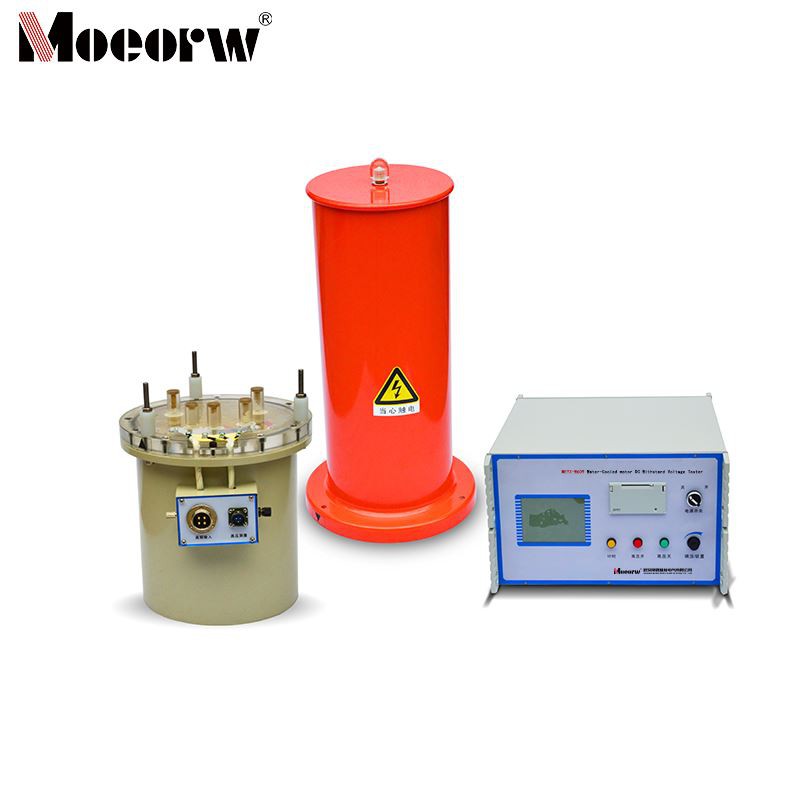


Water-Cooled motor DC Withstand Voltage Tester
Product Introduction
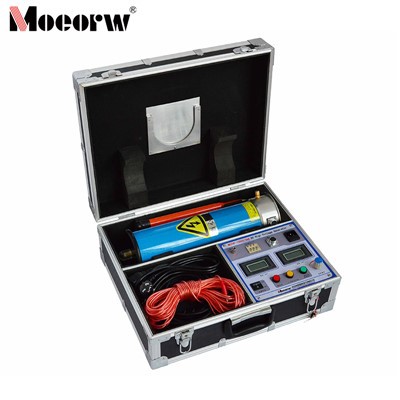
Water-Cooled Motor DC Withstand Voltage Tester This testing apparatus represents our company's next-generation, intelligent, LCD-displayed specialized testing instrument developed based on the "low-voltage shielding" principle and building upon our previous generation of products. It employs core technology from high-power DC high-voltage generators, replacing traditional testing components such as test transformers, high-voltage silicon stacks, voltage-stabilizing capacitors, rectifier capacitors and inductors, DC high-voltage dividers, voltage regulators, mA meters, μA meters, and polarization potential compensation devices. All these components are integrated into a single high-voltage (generation) unit and a control cabinet. This significantly reduces the number of individual components in the complete test setup, substantially lowers the weight of the test equipment, eases the workload for test personnel, simplifies test wiring, and makes testing more convenient, efficient, and reliable. Additionally, electronic voltage regulation, automatic polarization compensation, and comprehensive protection functions ensure simpler and safer operation. The adoption of medium-frequency voltage multiplication delivers more ideal test voltages, resulting in more accurate, stable test data and more reliable outcomes.
Product Parameter (specification)
|
Specifications/ Parameters |
60/80 |
60/120 |
60/200 |
60/300 |
80/200 |
80/300 |
90/150 |
100/250 |
|
Output voltage (kV) |
60 |
60 |
60 |
60 |
80 |
80 |
90 |
100 |
|
Output current (mA) |
80 |
120 |
200 |
300 |
200 |
300 |
150 |
250 |
|
Output power (kW) |
4.8 |
7.2 |
12 |
18 |
16 |
twenty four |
13.5 |
25 |
|
Chassis weight (kg) |
17 |
33 |
35 |
38 |
38 |
39 |
36 |
40 |
|
Pressure multiplier weight (kg) |
18 |
10+24 |
10+24 |
14+37 |
15+36 |
15+37 |
14+25 |
17+38 |
|
Pressure multiplier cylinder height (mm) |
630 |
730 |
730 |
900 |
900 |
900 |
850 |
1000 |
|
Voltage measurement error |
1.0% ± 2 characters |
|||||||
|
Total current measurement error |
1.0% ± 2 characters |
|||||||
|
Leakage current measurement error |
±2.0% (full scale) |
|||||||
|
Overvoltage setting error |
≤1% |
|||||||
|
voltage stability |
1.0% (random fluctuations, power supply voltage variations ±10%) |
|||||||
|
working methods |
Rated load continuous operation ≤5 minutes |
|||||||
|
Ambient temperature |
-10℃~40℃ |
|||||||
|
relative humidity |
At a temperature of 25℃, the concentration should not exceed 90% (no condensation). |
|||||||
|
Altitude |
Below 2000 meters |
|||||||
Product feature and application
The DC withstand voltage test and DC leakage current test for water-cooled motors are conducted under two conditions: with or without external water blowing. The respective advantages and disadvantages are compared as follows:
1. Testing with water blowing
Advantages: Can be performed using standard DC high-voltage testers. The equipment is lightweight, operation is simple, readings are accurate, and results are unaffected by water quality.
Disadvantages: Due to the generator unit's structure, accumulated water at the bottom is difficult to blow dry. This process is highly time-consuming, often requiring over a week of blowing. It extends the overhaul downtime. Incomplete blowing not only introduces measurement errors but also risks damaging windings if arcing occurs within the coil during testing.
2. Testing with Water Circulation
Advantages: Eliminates the need for blowing equipment and saves blowing time.
Disadvantages: Current methods combine AC test transformers (or resonant transformers) with silicon stacks and capacitors, requiring additional polarization compensation devices for water collection pipes. Equipment is bulky, dispersed, and involves complex wiring. Test results are affected by water quality, causing significant microampere meter fluctuations and difficult readings.
Considering the above, overcoming both drawbacks requires a specialized integrated system enabling testing under water conditions with portability, simplicity, and accuracy. Our company's "Water-Cooled Generator DC High-Voltage Test Device," developed based on the "low-voltage shielding method" principle, fundamentally meets these requirements. Its key features include:
1) The entire system consists solely of a control cabinet and a voltage multiplier unit, featuring extremely simple wiring.
2) Utilizes electronic control and tuning for convenient, comfortable operation; voltage, current, and other parameters are directly readable on panel meters without conversion.
3) Includes one-minute timing and prompt functions, configurable per test procedure requirements.
4) Comprehensive overvoltage and overcurrent protection capabilities.
Prodection details
The application scope focuses on insulation performance testing scenarios for water-cooled motors, specifically covering the following core areas:
1.Power Generation Side of Power Systems (Core Application Scenarios)
Large hydroelectric generators
Steam turbine generators
2. Industrial self-owned power plants / power stations
Suitable for self-owned power stations of large industrial enterprises such as steel, chemical, metallurgical, and cement industries, as well as data centers and urban heating stations
3. Motor manufacturing and maintenance industry
4. Water-cooled motor testing in special scenarios
Company Qualifications
Hot Tags: water-cooled motor dc withstand voltage tester, China water-cooled motor dc withstand voltage tester manufacturers, factory, Multi-Function Generator Rotor AC Impedance Tester, Water Cooled Generator Insulation Resistance Tester, Power Recorder Analyzer, generator testing equipment, Turbine Speed Control System Simulation Tester, Water Cooled Motor DC Withstand Voltage Tester