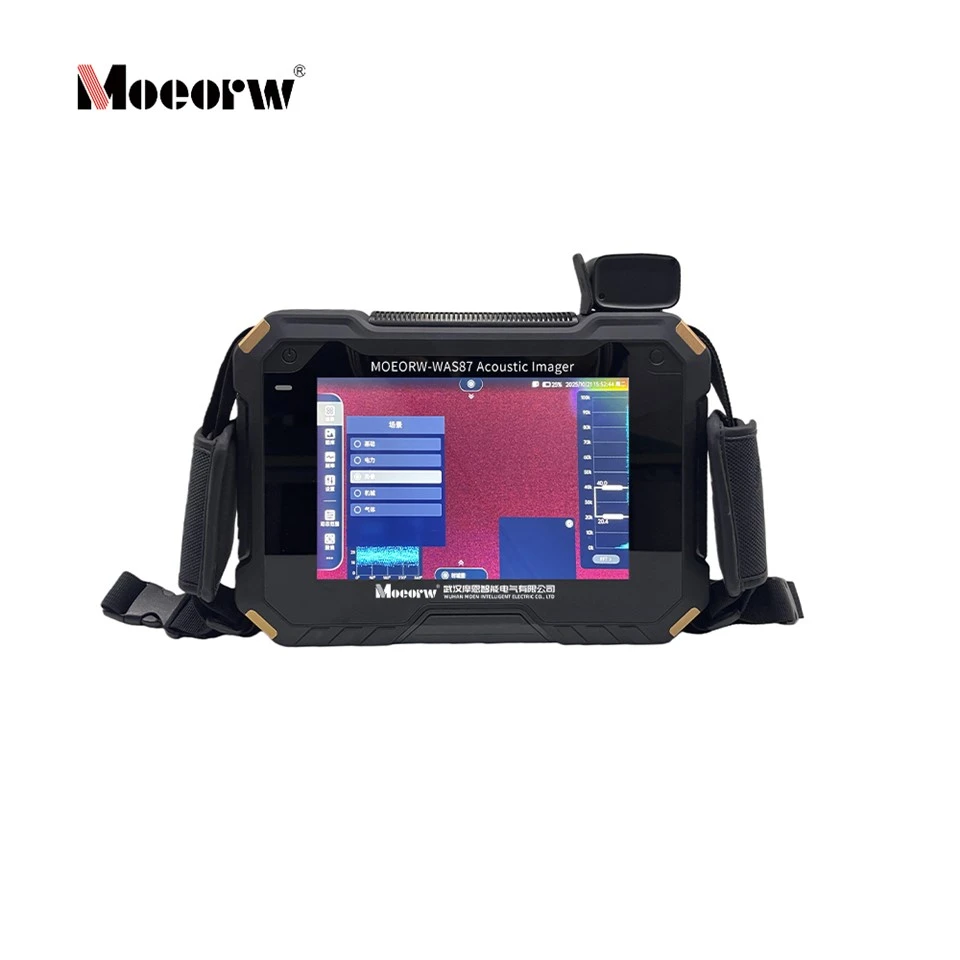


Product Overview
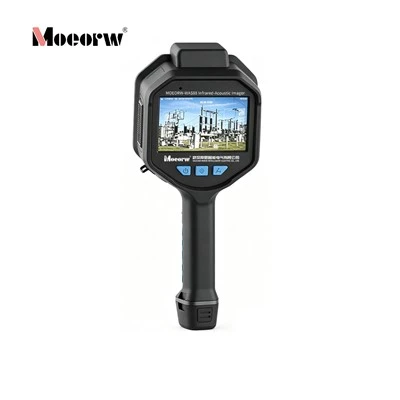
The MOEORW-WAS87 industrial infrared acoustic imager adopts microphone array beamforming technology to collect spatial sound source distribution data, synchronously captures visible light video via a high-definition camera, and realizes acoustic-optical fusion visualization of sound signals. It delivers over 10 times faster positioning efficiency for gas leakage and electrical partial discharge compared with conventional detection instruments.
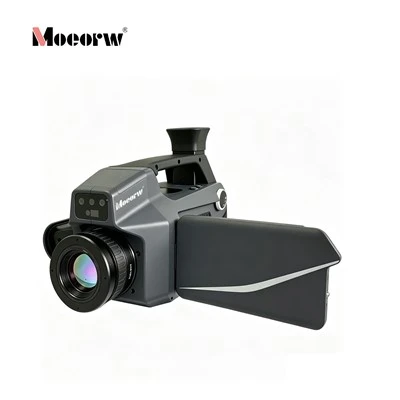
The device supports three dedicated test modes: Basic, Power, and Mechanical. In power inspection scenarios, it generates real-time PRPD patterns to classify partial discharge types and assess fault severity. When paired with an optional infrared thermal imaging module, it simultaneously displays acoustic cloud maps and thermal temperature data. Supporting USB PD fast charging, multi-mode wireless communication, and on-site report generation, it integrates full-process data collection, analysis, and output for industrial predictive maintenance workflows.
Product Parameters
Core Hardware Specifications
|
Category |
Item |
Specification |
|
Microphone Array |
Microphone Quantity |
208-channel high-sensitivity MEMS digital microphones |
|
Array Size |
143 mm |
|
|
Test Frequency Band |
20 Hz – 100 kHz; configurable analysis bandwidth 2 kHz – 100 kHz |
|
|
Acoustic Measurement |
Sound Pressure Level (SPL) Range |
28 dB – 130 dB (dBSPL) |
|
Minimum Detectable Leakage |
3 ml/min (10 m distance, 0.6 MPa pressure) |
|
|
Field of View (Acoustic & Visible Camera) |
66° diagonal |
|
|
Minimum Frame Rate of Acoustic Image |
≥25 FPS |
|
|
Visible Camera |
Pixels |
13 MP |
|
Fixed Focal Length |
4.3 mm |
|
|
Display Unit |
Screen Size & Resolution |
8-inch capacitive touch screen, 1920*1200 color |
|
Brightness |
≥600 cd/m², auto/manual brightness adjustment |
|
|
Storage |
Built-in Storage |
64 GB TF card + 64 GB internal backup storage |
|
Supported File Formats |
Image: .jpg; Video: .mp4; Raw acoustic data: .cdat; Audio: .wav |
|
|
Interfaces |
USB-C 1 (USB3.0) |
Charging, data export, HDMI video output via adapter |
|
USB-C 2 (USB2.0) |
Dedicated port for optional infrared thermal module, 5 V power output |
|
|
3.5 mm Audio Jack |
Real-time ultrasonic audio monitoring |
|
|
4-channel Analog Input |
IEPE/ICP support, 192 kHz / 384 kHz sampling rate, external vibration/ultrasonic contact sensor compatible |
|
|
SIM Card Slot |
Optional 4G/5G cellular communication |
|
|
Battery & Physical Size |
Battery Pack |
Detachable 6600 mAh @7.2 V lithium-ion battery, runtime >5 hours |
|
Equipment Weight |
1.24 kg (excluding battery and hand strap) |
|
|
Overall Dimension |
270 * 190 * 51 mm |
|
|
Housing Material |
PC+ABS dual-color injection molding |
|
|
Operating Environment |
Operating Temperature |
-20 ℃ ~ +50 ℃ |
|
Protection Grade |
IP54 |
|
|
Drop Resistance |
Drop Test Standard |
1.5 m free fall resistance |
Optional Infrared Thermal Module Parameters
|
Item |
Specification |
|
Thermal Resolution |
640*512 |
|
Frame Rate |
25 FPS |
|
NETD |
60 mK @25 ℃, F#1.0 |
|
Temperature Measurement Range |
-20 ℃ ~ 550 ℃ |
|
Temperature Accuracy |
±3% of reading or ±3% of full scale (whichever is larger) |
|
Thermal Field of View |
32.9° * 26.6° (13 mm lens) |
|
Effective Thermal Test Distance |
Up to 30 m |
Wireless Communication & Positioning
|
Item |
Specification |
|
Wi-Fi |
802.11a/b/g/n/ac, local hotspot function |
|
Bluetooth |
BT 5.2, compatible with wireless headsets |
|
Satellite Positioning |
Beidou, GPS, GLONASS, Galileo; geo-tagging for all captured media |
|
Cellular Module |
Optional 4G/5G communication |
EMC & Safety Standards
|
Item |
Standard & Grade |
|
National Safety Norm |
GB/T 19517-2023 |
|
ESD Immunity |
Level 3 |
|
Power Frequency Magnetic Field Immunity |
Level 5 |
|
RF Electromagnetic Field Immunity |
Level 4 |
|
Electrical Fast Transient Burst Immunity |
Level 3 |
|
Surge Immunity |
Level 2 |
Product Features
Multi-channel High-sensitivity Acoustic Hardware Design
Equipped with a 208-channel MEMS microphone array, the hardware supports full-spectrum acoustic capture from 20 Hz to 100 kHz. It achieves a minimum detectable gas leakage of 3 ml/min under standard test conditions, delivering stable acoustic imaging within 0.5 m – 240 m detection distance. The 66° wide field of view eliminates blind zones for large-area equipment inspection.
Three Independent Dedicated Test Modes with Targeted Analysis Algorithms
1.Basic Mode: Real-time acoustic cloud imaging for general gas leakage and random noise detection, supporting time-domain and spectrogram visualization.
2.Power Mode: Embedded PRPD pattern algorithm to identify corona, surface, and floating partial discharge; automatically outputs fault severity grading and maintenance suggestions.
3.Mechanical Mode: Supports up to 5 customizable frequency points for synchronous vibration signal analysis to locate bearing, roller and belt abnormal noise sources.
Integrated Visible-Acoustic-Thermal Co-display System (Optional Thermal Module)
The 8-inch high-brightness touch screen supports split-screen and floating-window display of visible video, acoustic cloud map, time-domain waveform, FFT spectrum and infrared thermal image. 1–6x digital zoom is available for both acoustic and thermal channels. Focus function suppresses background noise to enhance tiny defect signal identification.
Rich Configurable Acoustic & Thermal Calibration Parameters
Adjustable acoustic parameters include imaging threshold, dynamic range (0.5–40 dB), steady/transient signal mode, and customizable cloud color palettes. The thermal module supports adjustable emissivity, distance compensation, multi-point/multi-area temperature measurement, and switchable temperature units (°C / °F / K).
On-site Data Recording, Tagging & Built-in Report Generation
Captured images, videos and raw acoustic data can be labeled via text, voice or auxiliary photos, with editable asset ID, voltage grade, equipment type and maintenance priority tags. The device locally generates editable Word inspection reports for basic, power and thermal inspection tasks without post-processing on a PC.
Multi-mode Wireless Transmission & Multi-interface Expandability
Wi-Fi, Bluetooth and optional 4G/5G enable wireless data transmission to mobile terminals and computers. USB3.0 Type-C supports HDMI external display and fast data export; the 4-channel analog input port connects external vibration and contact ultrasonic sensors for extended offline testing.
Robust Industrial Hardware & Low-power Control Logic
IP54 dust/water resistance, 1.5 m drop resistance and -20 ℃ ~ +50 ℃ wide operating temperature adapt to harsh industrial sites. Detachable 6600 mAh lithium battery offers over 5 hours continuous runtime; auto-sleep, auto-shutdown and low-power mode further extend field operation time.
Product Application Scope
1.Power Grid & Electrical Equipment Inspection
Detect partial discharge of transformers, insulators, switchgears, busbars and high-voltage transmission lines; classify discharge types via PRPD patterns and evaluate insulation aging risks.
2.Petrochemical & Pipeline Leakage Detection
Locate tiny gas leakage points on valves, flanges, pressure vessels and long-distance pipelines; measure leakage volume and record geo-tagged inspection data for pipeline integrity management.
3.Mechanical Equipment Predictive Maintenance
Identify abnormal vibration noise of bearings, gearboxes, conveyor rollers, pumps and fans; monitor mechanical degradation via multi-frequency point spectrum analysis to schedule predictive maintenance.
4.Manufacturing Factory General Equipment Inspection
Compressed air pipeline leakage, vacuum system failure, factory equipment abnormal noise diagnosis under basic test mode.
Integrated Thermal-Acoustic Compound Fault Diagnosis Combined with optional infrared thermal module for simultaneous detection of overheating defects and acoustic leakage/discharge faults in electrical cabinets, motor equipment and heat exchange systems.
Equipment Daily Maintenance Guidelines
Routine Daily Maintenance
1.After each field operation, wipe the microphone array, visible camera and thermal lens (if equipped) with dry microfiber cloth to remove dust, oil and moisture; do not use corrosive chemical cleaners.
2.Check the battery compartment sealing rubber strip and equipment housing for damage before storage to maintain IP54 protection performance.
3.Store the device in a dry environment with temperature ranging from -20 ℃ to +40 ℃; remove the lithium battery if storage duration exceeds 2 months, and recharge the battery every 60 days to prevent capacity attenuation.
Battery Maintenance Specifications
1.Only use PD 9 V adapters with minimum 27 W output for charging; charging duration shall not exceed 24 hours continuously.
2.Prohibit charging the battery under ambient temperature above 45 ℃; avoid direct sunlight exposure during charging or field operation.
3.Do not disassemble the lithium battery module; stop charging immediately if abnormal heat or swelling occurs, and contact authorized service personnel.
Long-term Storage Rules
1.Fully charge the battery before long-term storage, then detach it from the main unit.
2.Place the device and battery in a cool, ventilated storage area away from open flames and high-temperature heat sources.
3.Disable the automatic positioning and hotspot functions when idle to reduce power consumption.
FAQ
Q1: The acoustic cloud map cannot display obvious leakage signals on site, what should I adjust?
A: Lower the imaging threshold value, disable steady mode to capture transient ultrasonic signals, and activate the focus function to filter out surrounding environmental noise; adjust the frequency band to match the actual leakage ultrasonic frequency range.
Q2: The device cannot charge normally via USB-C port
A: Verify the power adapter supports USB PD 9 V output with power ≥27 W; inspect the USB-C cable and port for damage, and clean foreign dust inside the charging interface.
Q3: PRPD patterns fail to display under power test mode
A: Confirm the scene is switched to Power mode; adjust the frequency band to match local grid frequency (default 50 Hz); ensure the sound source distance is within the effective detection range of 0.5–240 m.
Q4: Infrared thermal image cannot be displayed after connecting the thermal module
A: Confirm the thermal module is inserted into USB-C 2 port; restart the device to reload thermal imaging drivers; check if the thermal module is a factory-matched optional accessory.
Q5: Recorded photos and videos cannot be found in the gallery
A: Check the selected target album before capture; verify the TF card is properly inserted and not damaged; use the search function to filter files by shooting date or asset tag information.
Q6: Short battery runtime during field inspection
A: Enable low-power mode and auto-screen brightness adjustment; turn off unused Wi-Fi, hotspot and positioning functions; replace with a fully charged spare lithium battery.
Hot Tags: all-in-one acoustic inspection camera, China all-in-one acoustic inspection camera manufacturers, factory