High-Voltage Wireless Phase Comparator
Product Introduction
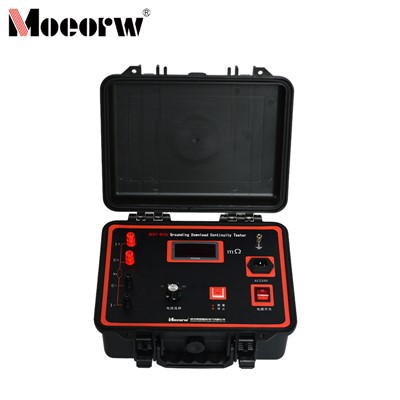
MOEORW-W0715B Ground Resistance and Soil Resistivity Tester, also known as Precision Ground Resistance Tester, Four-Wire Ground Resistance Tester, Two/Three/Four-Wire Ground Resistance Tester, and Soil Resistivity Tester, consists of a main unit, data software, test leads, auxiliary grounding rods, communication cables, and other components. The main unit features a dedicated toolbox design, manufactured from polypropylene plastic with advanced composite fillers through single-shot injection molding. This construction delivers superior properties including low density, enhanced strength, rigidity, hardness, wear resistance, heat resistance, and insulation performance. The enclosure can withstand approximately 200kg of pressure, ensuring high precision, stability, and reliability in diverse environmental testing conditions. The main unit features an oversized LCD display with backlighting and bar graph indicators for clear, at-a-glance readability. It can store up to 300 sets of data, and through the data software, users can access, review, save, generate reports, and print historical data.
Product Parameter (specification)
|
Function |
Ground resistance, soil resistivity testing; ground voltage, AC voltage testing |
|
Power Supply |
11.1V 2600mAh rechargeable lithium battery |
|
Backlight |
Adjustable white-screen backlight, suitable for dim environments |
|
Measurement Methods |
Precision 4-wire, 3-wire method measurement, simplified 2-wire ground resistance measurement |
|
Measurement Methods |
|
|
Ground Resistance |
Rated current polarity reversal method, measurement current 20mA max |
|
Soil Resistivity |
Four-pole method (Werner method) |
|
Ground Voltage |
Average value rectification (between P(S)-ES terminals) |
|
Measurement Range |
|
|
Ground Resistance (R) via 2/3/4-wire methods |
0.000Ω to 200.0kΩ |
|
Soil Resistivity (ρ) |
0.000 Ω·m to 9999 kΩ·m |
|
Ground Voltage |
AC 0.001 V to 600 V (50 Hz/60 Hz) |
|
Maximum Resolution |
|
|
Ground Resistance (R) via 2/3/4-wire method |
0.001 Ω |
|
Soil Resistivity (ρ) |
0.01 Ω·m |
|
Grounding voltage |
0.001V |
|
Accuracy |
Two-three-four-wire method measurement Grounding resistance (R) |
|
1. 0.000Ω~10.00kΩ |
±2% of reading ±5 digits |
|
2. 10.0kΩ~100.0kΩ |
±3% of reading ±5 digits |
|
3. 100.0kΩ to 200.0kΩ |
±3.5% of reading ±5 digits |
|
Note |
Additional error at 5V interference voltage ≤ ±5% of reading ±5 digits |
|
Soil resistivity (ρ) |
Determined by R measurement accuracy |
|
(ρ = 2πaR (a |
1m to 100m); π = 3.14) |
|
Grounding voltage |
±2% of reading ±5 digits (50Hz/60Hz) |
|
Test voltage waveform |
Sine wave |
|
Test frequency |
412Hz, 825Hz, 1280Hz (auto-selection) |
|
Short-circuit test current |
AC 10mA max |
|
Open-circuit test voltage |
AC 90V max |
|
Electrode Spacing Range |
1m to 100m |
|
Automatic Range Switching |
|
|
Ground Resistance |
0.000Ω to 200kΩ |
|
Soil Resistivity |
0.00Ω·m to 9999kΩ·m |
|
LCD |
6-digit LCD display with white backlight |
|
LCD Size |
128mm × 75mm |
|
LCD Display Area |
124mm × 67mm |
|
Measurement Indication |
LED flashes during measurement, LCD countdown, progress bar indicator |
|
Dimensions |
Instrument size;Approx. 320mm (L) × 275mm (W) × 145mm (H) |
|
Outer Packaging Dimensions |
Approx. 400mm (L) × 245mm (W) × 335mm (H) |
|
Standard Test Leads |
4 pieces;Red 15m, Black 15m, Yellow 10m, Green 10m |
|
Simplified Test Leads |
2 pieces;Red 1.6m, Black 1.6m |
|
Auxiliary Grounding Rods |
4 pieces;Approx. φ10mm × 200mm |
|
Measurement Frequency |
|
|
Ground Voltage |
Approx. 2 times/second; Ground Resistance |
|
Approx. 7 seconds/measurement; Soil Resistivity |
Approx. 7 seconds/measurement |
|
Measurement Capacity |
|
|
Over 5000 measurements (Short-circuit test |
1 measurement, pause 30 seconds before next measurement) |
|
Line Voltage |
|
|
Measures below AC 600V |
|
|
Communication Interface |
USB interface for data upload to computer and storage/printing |
|
Communication Cable |
1 USB cable, 1.5m long |
|
Data Hold |
"HOLD" symbol indicates data retention |
|
Data Storage |
300 sets; "HOLD" storage indicator; "FULL" displays when storage is full |
|
Data Review |
"READ" symbol indicates data review |
|
Overflow Display |
"OL" symbol indicates when measurement exceeds range |
|
Interference Detection |
Automatically identifies interference signals; "NOISE" symbol indicates when interference voltage exceeds 5V |
|
Alarm Function |
Emits "beep-beep-beep" alarm when measurement exceeds preset alarm value |
|
Battery Voltage |
Low battery voltage symbol displays when battery voltage is insufficient, prompting recharge |
|
Auto Power Off |
Automatically powers off after 15 minutes of inactivity |
|
Operating Current |
Standby;25mA max (backlight off); Backlight;25mA max (backlight only); Measurement;150mA max (backlight off) |
|
Weight |
Instrument;Approx. 2.66kg (including battery) |
|
Total Weight |
Approx. 6.88kg (including packaging) |
|
Toolbox |
Military-grade toolbox design, rated for 200kg load capacity |
|
Operating Temp/Humidity |
-10°C to 40°C; ≤80% RH |
|
Storage Temp/Humidity |
-20°C to 60°C; ≤70% RH |
|
Overload Protection |
Ground resistance measurement |
|
C(H)-E, P(S)-ES ports |
AC280V/3 seconds |
|
Insulation Resistance |
>20MΩ (500V between circuit and housing) |
|
Withstand Voltage |
AC3700V/rms (between circuit and housing) |
|
Electromagnetic Characteristics |
IEC61326 (EMC) |
|
Compliance |
Safety Standards IEC61010-1 (CAT III 300V, CAT IV 150V, Pollution Degree 2); IEC 61010-031; IEC 61557-1 (Grounding Resistance); IEC 61557-5 (Soil Resistivity); JJG 366-2004 (Grounding Resistance Meter) |
Product feature and application
1. **Multi-Functional**:
Supports ground resistance, soil resistivity, ground voltage, and AC voltage measurements, suitable for power, construction, lightning protection, and other scenarios.
01
2. **Precision Measurement**:
Utilizes 4/3/2-wire methods for ground resistance and 4-pole method for soil resistivity. Incorporates FFT and AFC technology for automatic interference suppression, achieving a maximum resolution of 0.001Ω.
02
3. **User-Friendly Operation**:
Features an extra-large backlit LCD display with progress bar and countdown indicators; automatic range switching; auto-shutdown after 15 minutes of inactivity; supports data hold, storage (300 sets), review, and computer upload/printing.
03
4. **Durable and Safe**:
Toolbox withstands 200kg load and high insulation. Features overload protection, overvoltage alerts, and alarm functions, compliant with IEC61010 and multiple safety standards.
04
5. **Stable Battery Life**:
11.1V 2600mAh lithium battery delivers over 5000 measurements on a full charge. Requires charging only once every 3 months during long-term storage.
05
Prodection details
- Power Industry: Ground resistance testing and soil resistivity measurement for power facilities such as power plants, substations, and transmission lines to ensure safe operation of power systems.
- Telecommunications Sector: Grounding system testing for communication base stations, equipment rooms, and transmission lines to guarantee interference resistance and operational stability of communication equipment.
- Meteorological Field: Ground resistance and soil resistivity testing for facilities like meteorological observation stations and radar stations to mitigate impacts from natural disasters such as lightning strikes.
- Oilfield Industry: Grounding system performance testing for oilfield extraction equipment and pipelines to prevent safety risks from static electricity or lightning strikes.
- Construction Industry: Lightning protection grounding resistance testing and soil resistivity measurement for buildings (especially high-rises and large venues) and construction sites, providing data for grounding system design.
- Lightning Protection Engineering: Grounding resistance and soil resistivity testing during installation, acceptance, and maintenance of lightning protection facilities to ensure compliance with protection standards.
- Industrial Electrical Equipment: Grounding system inspections for industrial equipment including factory production lines, heavy machinery, and electrical control cabinets to safeguard equipment operation and operator safety.
- Other Scenarios: Grounding resistance, soil resistivity, and related voltage measurements at locations such as airports, railways, and chemical industrial parks to meet safety protection and compliance testing requirements across diverse sites.
Company Qualifications
Hot Tags: soil resistivity ground resistance tester, China soil resistivity ground resistance tester manufacturers, factory, Portable Digital Earth Resistance Tester, Handheld Earth Continuity Resistance Tester, Soil Resistivity Ground Resistance Tester, Insulation Resistance Meter Calibration Device, Large scale Grounding Grid Resistance Tester, AC/DC Earth Resistance Tester