
Product Overview
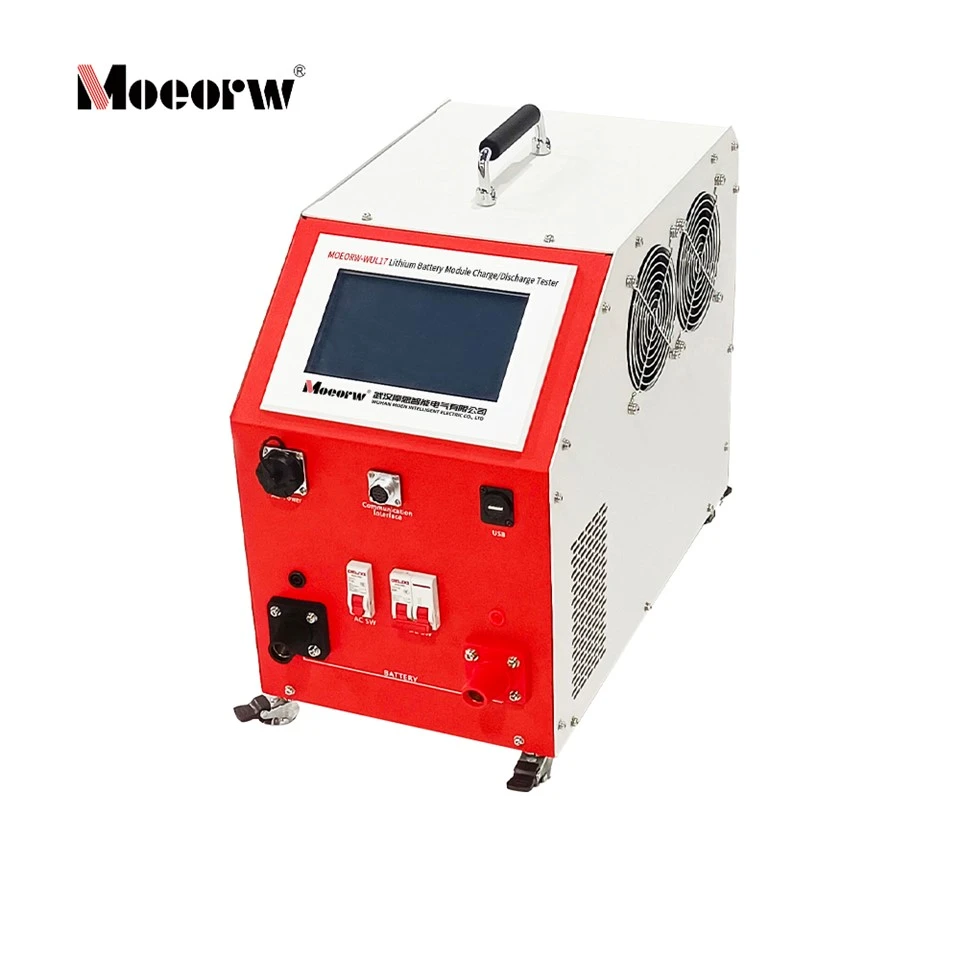
The MOEORW-WUL17 charge-discharge tester integrates built-in electronic load to conduct full-performance discharge tests on battery packs with DC voltage ranging from 2 V to 300 V. It supports constant-current and constant-power discharge as well as three-stage automatic charging for lithium and lead-acid battery packs.
The device adopts advanced hardware and control algorithms complying with national battery testing and maintenance specifications. It real-time monitors pack voltage, loop current, discharge duration, cumulative capacity and single-cell voltage throughout testing. Applicable scenarios include battery activation, initial charging pre-discharge, routine maintenance inspection, and capacity verification of battery packs. Equipped with a built-in high-power resistive load and a 7-inch touch HMI, the tester supports LORA wireless single-cell monitoring and USB offline data export. Matched PC analysis software enables curve visualization and standardized test report generation, lowering manual labor and optimizing battery maintenance workflows for UPS, energy storage and power supply enterprises.
Core Technical Specifications
Physical Dimensions & Mechanical Parameters
|
Item |
Parameter |
|
Model |
MOEORW-WUL17 Lithium Battery Module Charge-Discharge Tester |
|
Overall Dimension (L×W×H) |
460 mm × 260 mm × 360 mm |
|
Main Unit Weight |
21.5 kg |
|
Cooling Mode |
Forced air cooling |
|
Shell Protection & Heat Dissipation |
Front & rear ventilation channels for unobstructed air circulation |
Electrical & Measurement Performance
|
Classification |
Technical Index |
|
AC Input Power |
Single-phase 220 V AC, 40–60 Hz |
|
Human-Machine Interface |
7-inch TFT resistive touch screen, 1024×600 resolution |
|
Data Storage |
128 MBit built-in FLASH; USB external data export |
|
Communication Interfaces |
1 × RS485, LORA wireless single-cell monitoring (optional) |
|
Voltage Measurement Accuracy |
±0.5%FS + 0.1 V |
|
Current Measurement Accuracy |
±1%FS + 0.1 A |
|
Display Resolution |
Pack voltage: 0.1 V; Pack current: 0.1 A |
|
Discharge Control Precision |
±1%FS constant current |
|
Discharge Operating Range |
DC 2–300 V, 0–100 A, max. 9 kW power |
|
Charge Operating Range |
DC 2–300 V, 0–100 A, max. 6 kW power |
|
Ambient Operating Temperature |
-5 ℃ ~ 50 ℃; Storage temperature: -40 ℃ ~ 70 ℃ |
|
Humidity Tolerance |
0–90% RH (40±2 ℃, non-condensing) |
|
Rated Altitude |
≤ 2000 m |
Protection & Safety Standards
|
Protection Item |
Threshold & Mechanism |
|
Over-temperature Protection |
Resistor cabinet cut-off at 85 ℃; Radiator cut-off at 100 ℃ |
|
Overcurrent & Runaway Current Protection |
Automatic stop via high-voltage DC breaker |
|
Reverse Connection Protection |
Hardware anti-reverse circuit with buzzer alarm |
|
Abnormal Cut-off Trigger |
AC power loss, main DC cable disconnection, overheating, overcurrent |
|
Alarm Output |
LCD text prompt + acoustic buzzer |
|
Withstand Voltage Test |
AC input to chassis: 2200 V DC / 1 min; DC circuit to chassis: 2200 V DC / 1 min |
Main Functional Features
Hardware Load Design
1.Custom nickel-chromium alloy load resistors with resistance tolerance controlled within ±0.001 Ω, delivering stable discharge under large current.
2.Ultra-low temperature coefficient minimizes performance drift under variable ambient temperature, improving environmental adaptability.
3.High impulse current resistance enables rapid response to instantaneous large current impact, ensuring continuous and reliable discharge process.
4.Compact structural layout boosts power density while reducing overall equipment volume and weight.
Intelligent Chip Control System
1.Closed-loop constant-current discharge algorithm automatically adjusts load resistance following battery voltage drop to maintain stable set current.
2.Real-time single-cell voltage sampling, with dynamic curve and bar chart display on HMI; the system automatically marks maximum and minimum voltage cells for performance differentiation.
3.Multi-dimensional threshold judgment logic supports stop triggers including terminal pack voltage, single-cell cut-off voltage, total discharge capacity and test duration.
4.Automatic conversion between discharge capacity and hour rate for accurate battery residual capacity evaluation.
Complete Charge & Discharge Test Modes
1.Discharge test: Two connection schemes (offline independent load / parallel with user equipment) support constant current / constant power operation; parameters can be modified mid-test.
2.Three-stage automatic charging: Constant current → constant voltage current reduction → trickle float charge, matching standard battery charging characteristic curves to avoid overcharging and extend service life.
3.Cycle test function supports repeated charge-discharge aging verification of battery packs.
Visual HMI & Data Management
1.7-inch high-brightness resistive touch screen with strong anti-interference performance, full touch parameter setting and status monitoring.
2.Optional LORA wireless single-cell monitoring module, each unit collects 6 single-cell voltages, reducing the total quantity of monitoring modules by 83% compared with single-cell-per-module schemes, compatible with 2 V / 4 V / 6 V / 12 V single cells.
3.Built-in historical curve storage, supporting real-time and retrospective review of pack voltage-current variation curves.
4.USB data export function; matched PC analysis software parses test logs, visualizes single-cell characteristic curves and exports standardized Word test reports.
Application Fields
Energy Storage Industry
1.Factory capacity inspection and cycle aging test for industrial & commercial energy storage power stations and household energy storage battery packs;
2.On-site operation and maintenance inspection of energy storage projects, including battery activation, consistency screening and degraded cell positioning.
UPS & Communication Power Supply Industry
1.Regular capacity verification and discharge maintenance of lead-acid and lithium backup battery packs for room UPS;
2.Acceptance test and faulty cell troubleshooting of storage batteries in communication base stations and data computer rooms.
New Energy Power Battery Industry
1.Charge-discharge capacity calibration and grading test of finished battery modules in lithium battery PACK factories;
2.Verification of cycle life and charge-discharge performance of power energy storage battery packs before delivery.
Rail Transit & Standby Power Supply
1.Performance test of on-board backup batteries for locomotives and subways;
2.Annual maintenance discharge test of storage batteries for DC operating power supplies in power plants and transformer substations.
Battery Recycling & Secondary Utilization Industry
1.Capacity screening and consistency sorting of retired power lithium batteries and lead-acid batteries;
2.Performance evaluation and charge-discharge activation repair before reassembly of secondary-use batteries.
Laboratories & Third-Party Testing Institutions
1.Charge-discharge characteristic test of new material cells in battery R&D laboratories;
2.Issuance of standardized battery capacity test reports by third-party testing institutions.
Common Fault Troubleshooting
|
Fault Phenomenon |
Inspection & Resolution |
|
All single-cell readings of one wireless module show 0 V |
Recheck the wiring sequence of LORA monitoring module |
|
First three single-cell values of every module display 0 V |
Reverse cable connection; rewire starting from the battery pack positive terminal |
|
Module indicator light stays off |
Ensure the module obtains a minimum 8 V power supply from battery cells |
|
Module flashes slowly but no single-cell data received |
Correct the total module quantity setting on the main unit or check module address range |
|
Buzzer alarms after connecting discharge cables |
Power cable positive and negative polarity reversed |
|
Discharge current stable while pack voltage maintains unchanged |
Battery pack remains connected to the original operating system without disconnection |
|
Uncontrollable discharge current |
Verify correct selection of internal/external current sensor parameters |
|
No discharge current output |
Confirm DC air breaker closed, power cable fully locked, and matched battery capacity range |
|
Frequent over-temperature alarms |
Adjust equipment placement to ensure unobstructed ventilation channel |
|
Current detected immediately after closing air breaker at power-on |
Internal discharge circuit damaged; return to factory for repair |
|
Failed data storage |
Reboot the tester; avoid switching internal/external storage during ongoing testing |
FAQ
Q1: What voltage and current ranges does the tester support for battery testing?
A1: Charge and discharge voltage coverage: 2–300 V DC; maximum charge/discharge current: 100 A; discharge max power 9 kW, charge max power 6 kW, applicable to multi-series lithium and lead-acid battery packs.
Q2: How many single cells can one LORA wireless monitoring module detect? What is the power supply requirement?
A2: Each module monitors up to 6 single cells; power supply range 8–100 V, recommended 12–24 V for stable wireless communication. Calculate total modules by total cell count ÷ 6, add one unit for remainder cells.
Q3: What is the three-stage charging logic of the tester?
A3: Stage 1: Constant current pre-charging; Stage 2: Constant voltage equalization with automatic current reduction; Stage 3: Low-current float charge to prevent overcharging and extend battery service life.
Q4: How to export test data and generate formal test reports?
A4: After testing, insert a USB flash drive to export log files; install the matched PC analysis software (not on system C drive) to import data, view voltage/current/capacity curves and export Word-format test reports. Office software is required on the computer.
Q5: What stop thresholds can be set for discharge testing?
A5: Termination triggers include pack terminal voltage, single-cell minimum cut-off voltage, total discharge capacity, preset test duration, and manual emergency stop via touch screen.
Q6: What protective functions does the equipment integrate?
A6: Built-in over-temperature, overcurrent, reverse connection, power cable disconnection and current runaway protection; high-voltage DC breaker executes emergency shutdown with sound and screen alarm prompts.
Hot Tags: lithium battery module charge/discharge tester, China lithium battery module charge/discharge tester manufacturers, factory