MOEORW-WGJ43 (400 kV-30 kJ) Impulse Voltage Generator
Product Introduction
The MOEORW-WGJ43 is a 400 kV / 30 kJ impulse voltage generator built on a classic 4-stage Marx circuit, rated at ±100 kV per stage. Designed in compliance with IEC 60060-1, it delivers lightning and switching impulse voltage tests up to 400 kV peak for mid-sized power equipment in factory test floors and high-voltage laboratories.
From the control console it can output the standard 1.2/50 µs full lightning impulse wave, 2–6 µs chopped waves, oscillating lightning waves, 250/2500 µs switching impulse waves, and steep-front waves up to 2500 kV/µs - covering the full set of impulse voltage test waveforms required by utility and equipment-manufacturing standards.
The tower uses epoxy-supported modular stages, so the 400 kV unit can be field-expanded up to 1500 kV by adding stages rather than replacing the whole system. A Siemens PLC-based control rack and weakly damped capacitive divider are integrated as standard, with amplitude accuracy within ±1% and no-load generator efficiency above 90%.
It is sized for users testing distribution-class transformers, bushings, surge arresters, cables and switchgear up to 400 kV.
Built on a 4-stage Marx circuit - four 1.5 µF capacitors charged in parallel to ±100 kV each, then series-discharged through triggered ball gaps to produce ±400 kV in a single microsecond impulse. How Marx generators work →
Product Parameter (specification)
I. Usage Conditions
1.1 The altitude shall not exceed 1000 meters;
1.2 The ambient temperature is -10℃ to +45℃, and the relative humidity is not greater than 90%;
1.3 Free from dust and corrosive gases;
1.4 The generator body should be reliably grounded nearby, and the grounding grid should have a low grounding resistance (below 0.5 ohms) and good impulse characteristics.
Rated Parameters
| Ratings | |
|
1. Nominal voltage |
±400kV |
|
2. Rated voltage |
±100kV |
|
3. Rated charging voltage |
±100kV |
|
4. Nominal energy |
30kJ |
|
5. Total impact capacitance |
0.375 µF |
|
6. Number of levels |
4 |
|
7. Capacitance |
1.5 µF |
|
8.Per-stage energy |
7.5 kJ |
|
9. Impulse output voltage |
>360 peak kV |
|
10. Amplitude adjustment error |
≤1% |
|
11. Minimum output voltage |
10% Un |
|
12. Synchronization Range |
Within the voltage range of 20% to 100% of the rated voltage, the synchronization range for positive and negative polarities is not less than 20%. |
|
13. Synchronous discharge runaway rate |
<2% |
|
14. Body inductance |
≤55 μH |
|
15. Ignition range |
10%-100%Un |
|
16. Charging voltage instability |
<±1.0% |
|
17. Deviation between charging voltage and reference voltage |
< ±1.0% |
| Waveforms | |
|
18. Standard lightning impulse voltage full wave |
1.2 ±30% ms / 50 ±20% ms |
|
19. Amplitude |
±3% |
|
20. Peak oscillation |
≤5% |
|
21. Rated voltage of the cutoff device |
300kV |
|
22. Standard deviation of cutoff time |
< ±0.2 ms |
|
23. Cutoff time range |
2–6 ms |
|
24. Overshoot |
<5% |
|
25. Delay method |
Electronic delay |
|
26. Generator efficiency
|
Full-wave lightning (no load)≥90% |
|
Standard lightning cutoff≥85% |
|
|
27. Voltage utilization factor |
When the load capacitance is below 2000pF, the voltage utilization factor of the standard lightning wave is ≥90%; when the load capacitance is below 4000pF, the voltage utilization factor of the standard lightning wave is ≥85%. |
|
28. Duration of use |
It can operate continuously with a charge-discharge cycle of once every 120 seconds when the voltage is above 70% of the rated voltage, and can operate continuously when the voltage is below 70% of the rated voltage. |
|
29. Output voltage waveform |
It can generate standard lightning impulse voltage full wave of ±1.2/50 microsecond, lightning impulse voltage chopped wave with chopped time in the range of 2 to 6 microseconds, oscillating lightning impulse voltage wave with wavefront time not exceeding 15 microseconds, standard operating impulse voltage wave of ±250/2500 microseconds, oscillating operating impulse voltage wave with wavefront time greater than 100 microseconds, and steep impulse voltage waves of various steepness (e.g., 1000 kV/microsecond, 2500 kV/microsecond). |
| Control & Protection | |
|
30. Control Section |
It can be manually controlled, constant current charging, charging voltage instability is no greater than ±1%, the deviation of charging voltage from reference voltage is no greater than ±1%, and the adjustable accuracy of charging voltage is ±1%. |
|
31. The support frame, DC charging unit, etc. can be expanded as required, up to the 1500kV level. Sufficient safety space and distance must be ensured at the test site. |
|
Product feature
1. Modular 4-Stage Marx Architecture - Expandable in the Field
100 kV per stage, 4 stages = 400 kV today. When your test voltage requirement grows, add stages on-site up to 1500 kV instead of buying a new generator. Epoxy-supported tower keeps the footprint small while meeting IEC 60060-1 clearances.
2. Waveform Accuracy You Can Document
Generates 1.2/50 µs full lightning wave, 2–6 µs chopped wave, 250/2500 µs switching wave, oscillating waves and steep-front waves up to 2500 kV/µs - with amplitude within ±3%, peak oscillation ≤5% and overshoot <5%. Every shot is captured and stored as a traceable test report.
3. Siemens PLC Closed-Loop Control
Constant-current charging with auto-setpoint tracking; charging voltage stability ≤±1.0%; amplitude adjustment error ≤1%. One-switch polarity reversal (positive/negative). Manual and fully automatic modes, opto-isolated for substation-grade noise immunity.
4. Measurement Chain Accuracy 0.5%
Movable weakly damped capacitive divider (ratio accuracy ±1%) feeding a 12-bit digital acquisition module; overall measurement accuracy 0.5%. Built for noisy factory environments - not just quiet R&D labs.
5. Efficiency and Duty Cycle Built for Production Testing
≥90% no-load lightning efficiency, ≥85% chopped wave; ≥90% voltage utilization under 2000 pF load. Runs one charge–discharge cycle every 120 s above 70% rated voltage, continuously below - suited to routine type-test batches, not just occasional R&D shots.
6. Layered Safety, Designed Around Real HV Lab Accidents
Single-point grounding ≤0.5 Ω; overvoltage / overcurrent / travel-limit / emergency-stop interlocks; audible alarm before firing; two-person operation required; HV end remains interlocked until residual discharge is confirmed. Motorized ball-gap adjustment removes manual HV-side work.
Applications
The MOEORW-WGJ43 is sized for routine and type impulse-voltage testing of distribution-class transmission and distribution equipment up to 400 kV. It is typically used in:
1. Power Transformers
Tests: Lightning impulse full wave (1.2/50 µs), chopped wave, switching impulse (250/2500 µs) on winding insulation.
Standard: IEC 60076-4 / IEEE C57.19.00.
Why 400 kV fits: Covers distribution and small substation-class transformers (up to ~230 kV system voltage, BIL 450–650 kV with margin). For EHV power transformers (≥500 kV class), step up to our 800–1500 kV range.
2. Bushings
Tests: Full and chopped lightning impulse on condenser and resin bushings; external insulation coordination.
Standard: IEC 60137.
Why 400 kV fits: Typical BIL for 145–245 kV class bushings (450–650 kV) is covered with headroom for chopped-wave tests.
3. Surge Arresters
Tests: Residual voltage under lightning impulse (8/20 µs current wave, paired with an impulse current generator); duty-cycle classification.
Standard: IEC 60099-4 / IEEE C62.11.
Note: Voltage impulse test is usually paired with a companion impulse current generator (8/20 µs); we supply integrated systems if needed.
4. Gas-Insulated Switchgear (GIS) & MV Switchgear
Tests: Lightning impulse voltage test on busbar, disconnectors, cable compartments; internal fault diagnostics.
Standard: IEC 62271-1 / IEC 62271-203.
Why 400 kV fits: Matches 72.5–145 kV GIS class; 245 kV class requires 600 kV+ generator.
5. Cables & Cable Accessories
Tests: Impulse withstand on XLPE cables, terminations and joints for distribution circuits.
Standard: IEC 60840 / IEC 62067.
Why 400 kV fits: Up to 132 kV cable system; 220 kV and above need higher-rated generators.
6. Insulators & Air Gaps
Tests: Lightning and switching impulse flashover studies; air-gap breakdown distance calibration; pollution-layer tests.
Standard: IEC 60060-1 / IEC 60168.
Use case: University and grid-research high-voltage laboratories.
Where It Is Installed
| Scenario | Typical user |
|---|---|
| Manufacturer routine & type test floor | Transformer / arrester / switchgear factories needing repeatable production shots |
| Third-party type-test & certification labs | KEMA-style, national grid labs, UL/CSA-equivalent houses |
| Utility R&D and commissioning | Grid companies investigating insulation failures and line insulation coordination |
| University / research HV laboratories | Students and researchers studying air-gap, pollution and novel insulation materials |
Scope of Supply
| Sub-assembly | Included components |
|---|---|
| Charging unit | DC resistive voltage divider; bidirectional SCR & constant-current inductor-capacitor; charging transformer (220 V / 50 kV, 5 kVA); 2DL-300 kV/300 mA HV silicon rectifier stack; protection resistor; electromagnetic auto-grounding device |
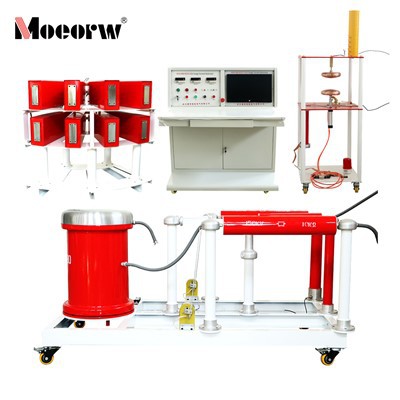
| Generator body | Per-stage main pulse capacitors (1.5 µF each); charging resistors; wavefront (damping) resistors; wavetail resistors; three-electrode firing ball gaps (φ250 mm) with motor drive; firing pulse unit; epoxy insulating columns; towable channel-steel chassis |
| Control console | Siemens PLC-based auto control system; 12-bit digital measurement module; HV pulse oscilloscope; touch/HMI; key switch; hard-wired E-stop |
| Measurement system | HID-series weakly damped capacitive divider (±400 kV, 300 pF, ±1% ratio accuracy); non-inductive low-arm capacitors; top grading shield; mobile cart; matched measurement cable (75 Ω) |
Optional: impulse current generator (8/20 µs), additional front/tail resistor sets for wider load-capacitance range, steepening unit, extra oscilloscope channels.
Right size for you?
The WGJ43 covers 400 kV class distribution T&D equipment. If your test object needs higher energy, the WGJ46 (400 kV / 60 kJ) handles larger capacitance loads; if you need higher voltage, our line runs from 20 kV teaching units up to 2400 kV UHV systems.
→ [Compare the full impulse voltage generator range]
→ [Not sure which model fits? Talk to an engineer]
Q: How is the after-sales service?
A: The warranty period is 12 months. After the warranty period, we also provide lifetime service paidrepair or service.
Q: What about transportation?
A: It depends on your requirements. We can ship to your airport by air, to your seaport by sea, or to your office by courier.
We also accept cooperation with your shipping agent.
Q: Are your keyboard, interface, software, and manuals in English?
A: Yes, if you are using the English version of the keyboard, interface, software, and manual and require other languages, please contact us for confirmation.
Q. What is a Marx generator?
A Marx generator charges a bank of capacitors in parallel through high-value resistors, then fires triggerable ball gaps to reconnect the capacitors in series, multiplying the output voltage for a single nanosecond-to-microsecond impulse. It is the standard topology behind almost every "impulse voltage generator" used in high-voltage testing.
Q. What does 30 kJ mean?
Nominal energy stored in the capacitor bank (½·C·V²). Higher kJ drives larger capacitance test objects (large power transformers, long cable runs) without losing waveform fidelity. The GJ43's 30 kJ covers distribution-class objects up to ~4000 pF load.
Q. Is 400 kV enough for my transformer?
It covers distribution and small substation-class transformers up to ~230 kV system voltage (BIL 450–650 kV). If you are testing 500 kV-class EHV power transformers, step up to our 1200 kV+ range.
Q. What is the difference between full wave and chopped wave?
A 1.2/50 µs full wave reproduces a natural lightning stroke reaching its peak in 1.2 µs and decaying to half in 50 µs. A chopped wave artificially terminates the wave at 2–6 µs to stress transformer inter-turn and inter-section winding insulation.
Q. How fast can it repeat shots?
Above 70% rated voltage, one full charge–discharge cycle every 120 seconds. Below 70%, continuous operation.
Q: How do I choose an impulse voltage generator?
A: Match voltage to your test object's BIL, energy to its capacitance, and decide on chopped-wave and automation. Read our full 6-step selection guide →
Q: What is a Marx generator circuit?
A: A Marx generator charges capacitor stages in parallel at low voltage and discharges them in series through triggered spark gaps to multiply the output. [See our annotated Marx circuit diagram →]
Hot Tags: 400 kV - 30 kJ Impulse Voltage Generator (4-Stage Marx Circuit), China 400 kV - 30 kJ Impulse Voltage Generator (4-Stage Marx Circuit) manufacturers, factory, turn to turn tester, 30kV VLF HV Generator, 25kA Impulse Current Generator, Impulse Coils Tester, digital interturn insulation testers, Turn to Turn Surge Withstand Tester