

Transformer Oil Chromatography Online Monitoring System
Product Introduction
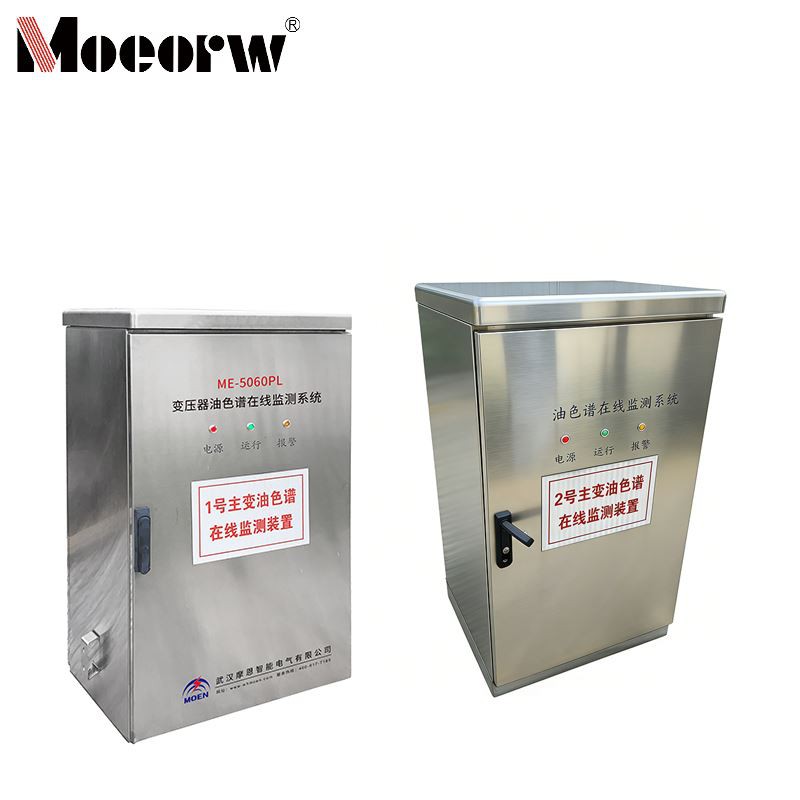
ME-W5060PL Transformer Oil Chromatography Online Monitoring System, compatible with 110kV and higher voltage transformers and related equipment. Utilizing advanced technologies such as vacuum ultrasonic degassing and cold traps, it accurately detects seven fault gases. Supporting TCP/IP and IEC 61850 protocols, it enables remote operation and maintenance. Equipped with intelligent fault diagnosis and alarm functions, it offers strong anti-interference capabilities and broad environmental adaptability, providing real-time, reliable assurance for the safe and stable operation of power equipment.
Product Parameter (specification)
2.1.1 Rated Data
Rated voltage: AC220V .
Power consumption: Under rated operating voltage, the power consumption is no more than 1000W .
2.1.2 Detection Indicators
Table 1 Gas Component Detection Indicators
|
gas components |
Minimum detectable concentration |
Measurement range |
Detection accuracy |
|
H 2 |
≤ 2 μL/L |
2 ~ 2000 μL/L |
±10% |
|
CH 4 |
≤1μL/L |
1 ~2000μL/L |
±10% |
|
C2H4 |
≤1μL/L |
1~2000μL/L |
±10% |
|
C2H6 |
≤1μL/L |
1~2000μL/L |
±10% |
|
C₂H₂ |
≤0.5μL/L |
0.5~500μL/L |
±10% |
|
CO |
≤5μL/L |
5~ 4000μL /L |
±10% |
|
CO2 ( optional) |
≤ 25 μL/L |
2.5 ~ 5000μL /L |
±10% |
|
H₂O ( optional ) |
2%RH |
2~100%RH |
±10% |
2.1.3 Monitoring Cycle
The minimum monitoring period is 2 hours. The monitoring period can be set arbitrarily according to the user's needs.
2.1.4 Repeatability
For the same oil sample ( calculated with an ethylene C2H4 concentration of 50 μL / L ) , five consecutive analyses of the gas composition in the oil were performed, and the difference between the test results did not exceed 10% of the average of the five analyses .
2.1.5 Measurement Error
While analyzing oil samples with gas content between the minimum and maximum detection limits, the same oil sample was also tested on a gas chromatograph. The measurement error was calculated based on the chromatograph data .
Measurement error : minimum detection limit or ±30%, whichever is greater .
2.1.6 Communication Interface
Electrical Ethernet interfaces: 2 , 10M/100M, RJ-45 .
Communication serial ports: 2 , RS485 .
2.1.7 External Dimensions
This product has a rectangular box shape and is made of 1.5 mm thick cold-rolled steel plate.
Specific dimensions are as follows : 1400mm Íx Í720mm x 420mm .
2.2 Environmental conditions
Ambient temperature: -40°C to +55°C ;
Relative humidity: 5%–95% with no condensation;
Atmospheric pressure: 80 kPa ~ 110 kPa ;
Altitude: 0~3000m .
2.3 Insulation performance
2.3.1 Insulation resistance
A. Under standard test conditions, the insulation resistance meets the requirements of Table 2 .
Table 2 Insulation resistance requirements under standard test conditions
|
Rated voltage Ur |
Insulation resistance value |
|
Ur≤60V |
≥5MΩ |
|
Ur>60V |
≥5MΩ |
|
Note: For port circuits directly connected to secondary equipment and external circuits, the insulation resistance must meet the requirement of Ur > 60V. |
|
B. Under constant damp heat test conditions of (+40±2)°C and (93±3)% relative humidity , the insulation resistance meets the requirements of Table 3.
Table 3 Insulation resistance requirements under constant humidity and heat conditions
|
Rated voltage Ur |
Insulation resistance value |
|
Ur≤60V |
≥1MΩ |
|
Ur>60V |
≥1MΩ |
|
Note: For port circuits directly connected to secondary equipment and external circuits, the insulation resistance must meet the requirement of Ur > 60V. |
|
2.3.2, Medium Strength
Under standard atmospheric conditions, the strength of the medium meets the requirements of Table 4 .
Table 4. Medium Strength Requirements
|
Rated voltage Ur |
Effective value of test voltage |
|
Ur≤60V |
0.5kV |
|
Ur>60V |
2.0kV |
|
Note: For port circuits directly connected to secondary equipment and external circuits, the dielectric strength requirement is Ur > 60V. |
|
2.3.3 Impulse Voltage
Under standard atmospheric conditions, a standard lightning impulse voltage is applied between the power supply and signal ports and the casing. When the rated voltage Ur > 60V , the test voltage is 5kV ; when the rated voltage Ur ≤ 60V , the test voltage is 1kV . No breakdown or component damage is observed in the device.
2.4 Mechanical properties
2.4.1 Vibration
Vibration resistance: 5Hz~17Hz 0.12″ double-peak displacement
17Hz~640Hz 1.7 peak-to-peak acceleration
2.4.2 Impact and Collision
Shock resistance: 10G peak-to-peak acceleration ( 12ms )
2.5 Anti-interference capability
2.5.1 Electrostatic Discharge Immunity Test
The device's enclosure ports can withstand electrostatic discharge immunity tests of level 4 as specified in GB/T 17626.2-2006 . Furthermore, the device operates normally after the interference disappears.
2.5.2 Immunity Test to Radiated Electromagnetic Fields
The device's outer casing can withstand power frequency magnetic fields of level 5 as specified in GB/T 17626.8-2008 and pulsed magnetic field immunity tests of level 5 as specified in GB/T 17626.9-1998 . Furthermore, the device operates normally after the interference disappears.
2.5.3 Immunity Test Against Radio Frequency Electromagnetic Fields
The device's housing ports can withstand the radio frequency electromagnetic field immunity test of level 5 as specified in GB/T 17626.3-2008 . Furthermore, the device operates normally after the interference disappears.
2.5.4 Immunity Test Against Fast Transients
The device's power port, communication port, input and output ports can withstand the electrical fast transient/burst immunity test of level 4 as specified in GB/T 17626.4-2008 . Furthermore, the device operates normally after the interference disappears.
2.5.5 Impact (Surge) Test
The device's power port, communication port, input, and output ports can withstand surge (impulse) immunity tests of level 4 as specified in GB/T 17262.5-2008 . When interference is applied to the power port and signal port, the device can operate normally within the range specified in the technical requirements; when interference is applied to the communication port, temporary communication interruption is permissible, but it can recover automatically. No component damage was observed.
2.5.6 Voltage sag and short-time interruption immunity test
The device can withstand a voltage sag and short interruption immunity test for a duration of 10 cycles at test level 40 as specified in GB/T 17626.11-2008 .
2.5.7 Immunity Test to Damped Oscillating Magnetic Fields
The device's outer casing port can withstand the damped oscillating magnetic field immunity test of level 5 as specified in GB/T 17626.10 . Furthermore, the device operates normally after the interference disappears.
2.6 Continuous power supply
Before leaving the factory, the device undergoes a continuous power-on test at room temperature for no less than 72 hours , and all parameters and performance indicators of the device meet the enterprise standards.
2.7 Safety Requirements
Protection rating: IP56
Product feature and application
1.4.1 Vacuum and Ultrasonic Oscillation Degassing Technology
The combined vacuum and ultrasonic oscillation degassing technology enables rapid and effective separation of dissolved gases in transformer oil under low vacuum conditions. By leveraging ultrasonic excitation and vacuum volatilization of solutes, it creates a self-sustaining cycle for dissolved gases without any intermediary media. This approach achieves high degassing efficiency, short processing times, and excellent repeatability while preventing contamination of transformer insulating oil.
01
1.4.2 Cold Trap Technology
During oil chromatography analysis, oil vapors contaminate the active components of the chromatographic column, severely impairing separation efficiency and shortening column lifespan. Typically, adsorbents (such as activated carbon) are used to filter and adsorb separated fault gases, effectively reducing column contamination. However, the activation and regeneration characteristics of adsorbents fail to meet the long-term stable operation requirements of online monitoring systems.
Cold traps achieve effective condensation of volatile organic compounds (C3 and above) in transformer oil under controlled low-temperature conditions. This approach completely prevents oil vapor contamination of the chromatographic column, enabling a maintenance-free system.
02
1.4.3 Composite Chromatographic Column
A single composite column replaces dual columns, simplifying system architecture. Under specified temperature conditions, the composite column effectively separates six fault gases: H₂, CO, CH₄, C₂H₆, C₂H₄, and C₂H₂. Peak areas for each gas remain constant across different isothermal conditions, preserving peak capture parameters for data processing. This makes it suitable for field-installed transformer oil online monitoring systems. The composite column features high column efficiency, excellent contamination resistance, and extended service life.
03
1.4.4 Gas Detector Technology
Utilizing integrated sensing technology, the sensitive element and control circuitry are integrated onto a unique ceramic silicon chip. The corresponding fault gas detection chamber is designed with minimal dead volume, significantly enhancing detection sensitivity.
Compared to FID and TCD sensors, it exhibits resistance to poisoning and extended service life. When contrasted with non-chromatographic detection methods, the detector features a simple structure, compact size, and high detection sensitivity.
04
1.4.5 Support for TCP/IP and IEC 61850 Communication Protocols
Data including gas component concentrations, carrier gas pressure status, and spectra can be transmitted to the process layer network via SV/GOOSE. Full support for TCP/IP communication protocols and IEC 61850 requirements enables seamless integration with third-party main IEDs for transformer condition monitoring in smart substations.
05
Prodection details
The ME-W5060PL Transformer Oil Chromatography Online Monitoring System is designed for operational condition monitoring of power transformers rated at 110kV and above, as well as high-voltage shunt reactors rated at 330kV and above. As a condition monitoring sensor-level device, it primarily performs local measurement of condition monitoring parameters for primary oil-filled equipment in smart substations and handles data communication functions. It meets the communication requirements of smart substations based on IEC 61850, enabling fully digital data acquisition and transmission.
Company Qualifications
Hot Tags: transformer oil chromatography online monitoring system, China transformer oil chromatography online monitoring system manufacturers, factory, Transformer Oil Chromatography Online Monitoring System, online monitoring testing equipment, Transformer Partial Discharge Online Monitoring Device