

Live-Line Instrument for Zinc Oxide Surge Arresters
Product Introduction
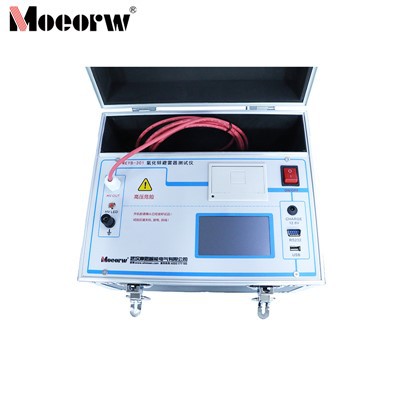
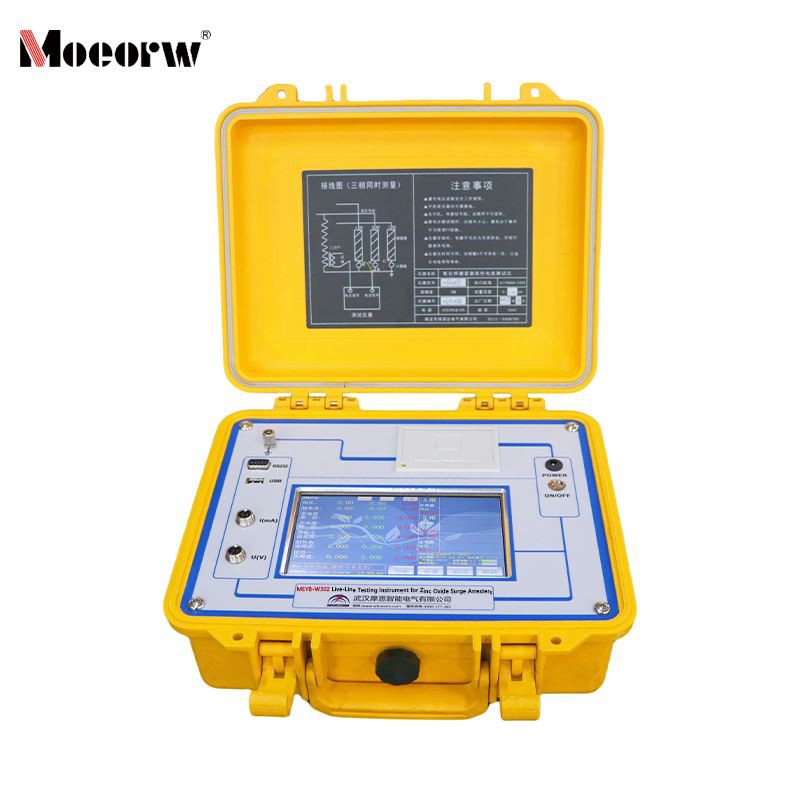
The MEYB-W302 Live-Line Testing Instrument for Zinc Oxide Surge Arresters is suitable for live or de-energized testing of zinc oxide surge arresters across various voltage levels, enabling timely detection of hazardous defects such as internal insulation moisture ingress and valve plate aging.
The instrument features simple operation and user-friendly design, with the entire measurement process controlled via a human-machine interface. It measures total current, resistive current and its harmonics, power frequency reference voltage and its harmonics, active power, and phase difference for zinc oxide surge arresters. A large screen displays true waveforms of voltage and current. Employing digital waveform analysis technology, the instrument utilizes software-based anti-interference methods such as harmonic analysis and digital filtering to ensure accurate and stable measurement results. It precisely analyzes fundamental wave content and harmonic content from the 3rd to 9th harmonics, while overcoming phase-to-phase interference to accurately measure the resistive current of edge-phase surge arresters.
Product Parameter (specification)
|
1. Power Supply |
Internal lithium battery or DC 8.4V adapter |
|
2. Measurement Range |
Leakage Current;0-20mA (expandable); (Optional;Current clamp sensor 0-20mA.) Voltage;30-250V (expandable); (Optional;Electric field strength input range;30kV/m~300kV/m.) Angle;0-360º Resistive current;0-20mA (expandable); Capacitive current;0-20mA (expandable); |
|
3. Measurement Accuracy |
Current;When total current >100μA;±5% of reading ±1 digit; Voltage;When reference voltage signal >30V;±5% of reading ±1 digit. |
|
4. Measurement Parameters |
|
|
Leakage Current |
Leakage Current;Full current waveform, fundamental rms value, peak value. Resistive Component of Leakage Current;Waveform, fundamental and harmonic rms values (1st, 3rd, 5th, 7th, 9th). Primary Peak Ir1p, Peak Irp. Capacitive Current Fundamental. Voltage;Voltage waveform, voltage rms value. Phase Angle Difference, Power Dissipation. |
|
5. Lithium Battery Parameters |
Charge time > 2.5 hours Continuous operating time > 7 hours Intermittent operating time > 7×24 hours |
|
6. Unit Dimensions |
Main unit;42cm × 34cm × 18cm |
|
7. Unit Weight |
Main unit;7.5kg |
Product feature and application
1. Color Touchscreen: 7-inch high-definition color touchscreen with 800×480 resolution for interactive operation.
2. Multiple Synchronization Methods: Supports wired synchronization (with voltage); voltage-free synchronization via software angle setting or current analysis method to determine voltage reference.
3. Live/Dead Line Compatibility: Suitable for use on energized surge arresters, de-energized lines, or laboratory environments.
4. Wide measurement range: Voltage range 0-250V, current range 0-20mA.
5. Simultaneous three-phase testing: Truly achieves simultaneous measurement of three-phase current and voltage, enhancing efficiency; also supports single-phase or two-phase testing for flexible selection.
6. Safe and reliable: Internal circuitry operates at low voltage (≤8.4V); current and voltage sensors are fully isolated for safety.
7. Selectable Voltage Methods: Supports using three-phase or phase B voltage as reference; supports phase B electric field strength via induction plate as voltage reference (optional), facilitating voltage sampling; supports voltage measurement in maintenance power terminal boxes (busbar-related).
8. Selectable Current Methods: Can sample leakage current by connecting wires to both ends of the surge arrester counter.
Alternatively, current clamps can be used to collect leakage current from the arrester's grounding wire (optional).
9. Standard anti-interference processing: Features anti-interference calculation and angle compensation functions, completely resolving mutual interference between phases. Meets requirements for 220kV and higher voltage levels.
10. Built-in lithium battery: Standard high-energy lithium-ion battery included, ideal for power-free environments.
11. High-speed sampling: High sampling frequency combined with advanced digital signal processing delivers strong anti-interference performance and extremely high measurement accuracy.
12. Built-in calendar clock: Provides time reference for printing and saving data.
13. Massive test data storage: Features large-capacity storage for extensive data retention. Includes data storage, browsing, and power-off protection functions.
14. USB Data Export: Equipped with USB data export functionality, exporting data as Word files.
15. Bluetooth Control and Data Upload: Standard Bluetooth capability with Android Bluetooth app. Control, upload, and generate Word files via smartphone or tablet after installing the app.
16. Customizable Background Colors: Adjust screen colors to patterned blue or black backgrounds. Configure background brightness, standby brightness, and standby duration.
17. Built-in Training Materials: On-screen guides display various wiring configurations for field operation reference.
18. English Input for Test Data: Enter site, equipment, personnel, and remarks in English for clear labeling and printing of test records.
19. Language Switching: Directly toggle between Chinese and English interfaces to accommodate both domestic and international usage scenarios (optional).
20. Portable Design: Desktop-style main unit with an integrated dustproof and corrosion-resistant enclosure. Compact size and lightweight construction ensure easy portability.
21. Optional State Grid Communication Protocol Support: Optionally supports RS232, RS485, or Bluetooth protocols. Protocol specifications vary by province; specify requirements during customization.
22. Optional Features: Standard versions do not include optional functions; customers may customize based on specific needs.
Prodection details
MEYB-W302 Zinc Oxide Surge Arrester Live Testing Instrument is a specialized device for testing the electrical performance of zinc oxide surge arresters.
Company Qualifications
Hot Tags: zinc oxide arrester tester, China zinc oxide arrester tester manufacturers, factory, lightning arrester and insulator test equipment, Zinc Oxide Arrester DC Parameter Tes, Zinc Oxide Arrester Tester, Insulator Tester, Lightning Arrester Counter Tester, Insulator Zero Value Tester